
Projection effects in determination of the merger time in shell galaxies with IllustrisTNG

Tuğba Erol 1 , Mustafa Kürşad  Yıldız 2,3 , Ivana Ebrová 4 , Michal  Bílek 5,6

  • 1 Erciyes University, Graduate School of Natural and Applied Sciences, Astronomy and Space Sciences, Kayseri
  • 2 Erciyes University, Faculty of Science, Astronomy and Space Sciences Department., Kayseri
  • 3 Erciyes University, Astronomy and Space Sciences Observatory Applied and Research Center (UZAYBİMER), 38039, Kayseri
  • 4 FZU – Institute of Physics of the Czech Academy of Sciences, Na Slovance 1999/2, Prague
  • 5 LERMA, Observatoire de Paris, CNRS, PSL Univ., Sorbonne Univ., Paris
  • 6 Collège de France, 11 place Marcelin Berthelot, 75005, Paris

Abstract

Stellar shells are low surface brightness features generally in the shape of concentric arcs. Stellar shells observed in many giant elliptical and lenticular, as well as a few spiral and dwarf galaxies, presumably result from minor and intermediate radial mergers of galaxies. Shells commonly occur near the nucleus and appear aligned with the galaxy's major axis. An essential factor in determining the merger time is the distance of the shells from the centre of the galaxy. Shells move away from the centre after they are created; therefore, the outermost shell indicates the lower limit of the merger time. Thus, we use the radius of the outermost shell to calculate the time of the merger. Based on the relation between the merger time and distance, the resulting merger time significantly changes if shells are further behind than the observed ones. Therefore, we need to look at galaxies from all angles and determine the distances of the shells. However, the visibility and radii of the shells change with the viewing angle; thus, we cannot see the shells behind the galaxy. We can only explore these effects in simulated galaxies. In our study, we investigate up to which precision the shell radii depend on the orientation of the galaxy with respect to the observer. We make use of the Illustris TNG50 simulation. We look at galaxies from 20 points of view angles and measure the distances of the shells. We calculate the merger time for each line of sight and evaluate how different orientation affects the results.

1- Merger Event

Not Collision, Merger!
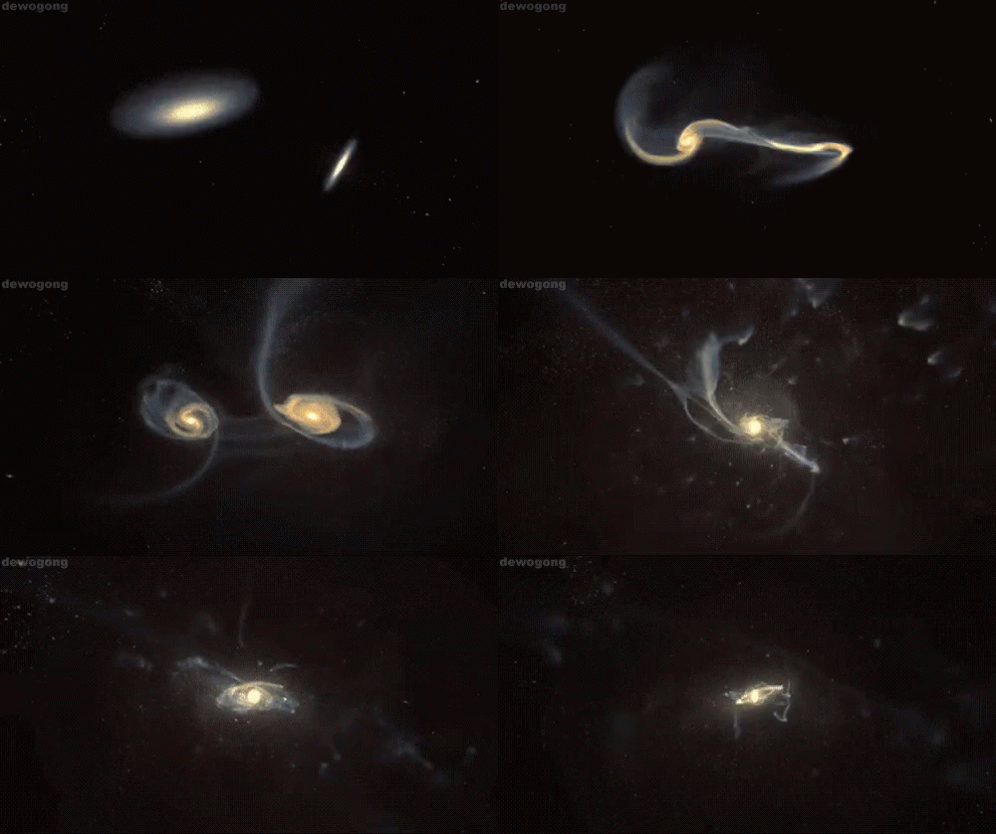
Simulation of the merger of two galaxies.


As galaxies merge, stars or planets do not collide with each other. Therefore, galaxy mergers are not called "collisions".

But gas and dust in galaxies collide. Thus, star formation regions are formed due to the gas/dust environments that are compressed and condensed.
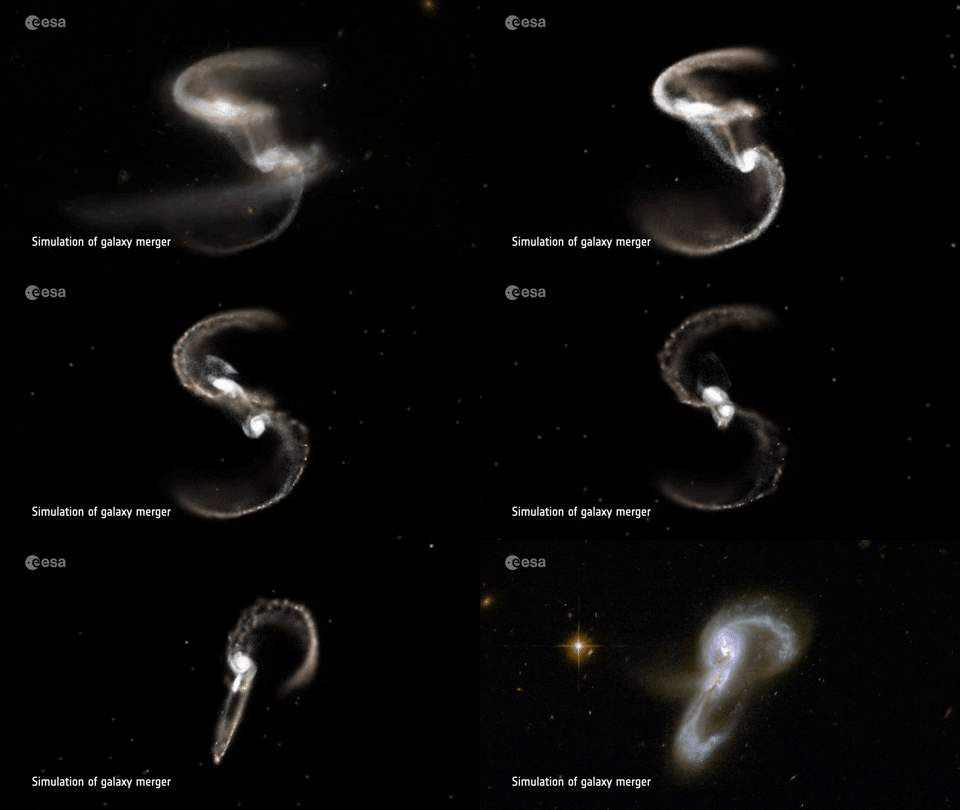
We can observe the merger event of galaxies when they are in different merger stages. ESA has prepared a simulation that shows what stage of mergers some galaxy observations are actually in.
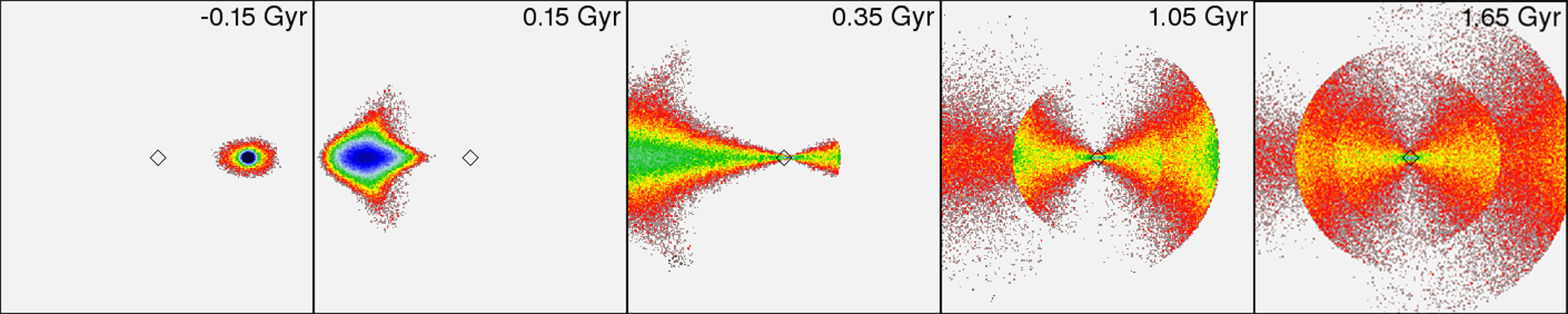
The diamond-shaped object represents the large galaxy at the center. The other object is a galaxy deformed by the tidal force. They oscillate within themselves.

Stellar shells are low surface brightness features generally in the shape of concentric arcs. Stellar shells observed in many massive elliptical and lenticular, as well as a few spiral and dwarf galaxies, presumably result mainly from minor and intermediate radial mergers of galaxies.


The shells are made of stars from the less massive merger progenitor. The velocities of the stars are the slowest at the turning points of their orbits thus the shell edges are situated near the apocenters of stars. The stars near the shell edge either move toward the edge or toward the galaxy center.  


Not all particles reach the apocenters at the same time. The first shell is formed when the stars with lowest kinetic energy reach their apocenters. The shells expand and move away with the energy of the particles that arrive after the first ones. With time, the outermost shell reaches higher galactocentric radii and more shells are created in the galaxy.

With time, the outermost shell reaches higher galactocentric radii and more shells are created in the galaxy. Therefore shell radii, especially the radius of the outermost one, can provide estimates of the merger time. 

3- Finding The Merger Time

The outermost shell indicates the lower limit of the merger time. We use the radius of the outermost shell to calculate the merger time. Based on the relation between the merger time and distance, the resulting merger time significantly changes if shells are further behind than the observed ones.

The shell edges are made of stars reaching their apocenters. The number of a shell, n = 0,1,2,..., is the number of complete oscillations performed by these stars since the moment they were released. An oscillation is defined as the movement between two subsequent apocenters; for example, the zeroth shell is made of stars near their first apocenter because they are just finishing one half of an oscillation. To approximation, at a time t after the decay of the secondary, the radius of a shell can be calculated as the radius at which stars just reach their apocenter. The nth shell is thus approximately located at distance rA,n from the center of the primary satisfying the equation  

  • P(r) denotes the period of radial oscillation at the galactocentric radius r .
  •  n = 0,1,2,..., the number of a shell, is the number of complete oscillations performed by these stars since the moment they were released. 
  • t, time after the decay of the secondary.

Click for more details to the calculation.

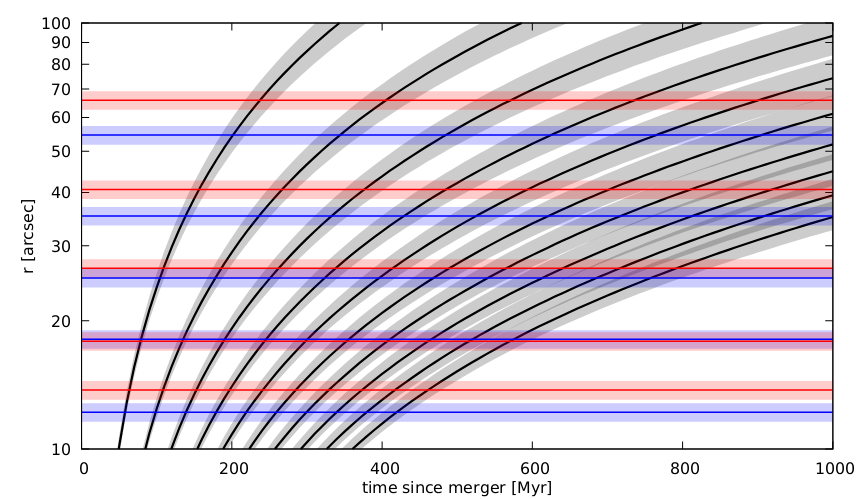
The graph below shows the evolution of NGC 4993's first ten shells.


This graph is taken from work done in 2019 by Ivana Ebrová, Michal Bílek, Mustafa K. Yıldız, and Jiří Eliášek. 

Black curves show the modeled evolution of the radii for the first ten shells in the gravitational potential of NGC 4993. The gray transparent regions correspond to the uncertainties in the halo mass and concentration. Red (blue) lines correspond to the actual shell edges north (south) of the center of NGC 4993. The transparent red and blue stripes correspond to the measurement errors of the shell radii, ±5 %, measured on the major axis of the galaxy .The best agreement of the modeled and measured number and radii of the shells occurs for the merger around 400 Myr ago. 

The results of our work will be a part of my master's thesis.

We aim to obtain a result as seen above, and to do this for other galaxies and obtain a statistic.

  • Results we want to achieve:
  • How do the distances and numbers of the shells change according to the line-of-sight?
  • A statistic based on the merger times of many galaxies.
  • How do the estimated merger times depend on the line-of-sight?

2- In Simulations

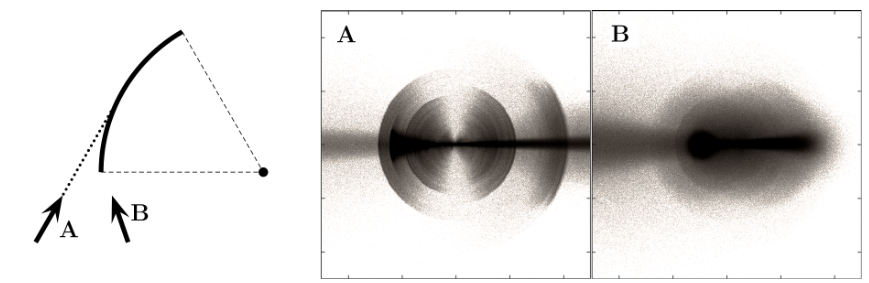
Shell appearance differs depending on the line of sight. In the three-dimensional space, a shell is a part of a spherical surface centered on the galaxy. The observer in direction A sees the shell as a sharp-edged structure. The observer viewing the shell from direction B does not see any part of the shell tangentially, and so the shell appears diffuse. The two images on the right show an illustrative simulation of a radial minor merger between two spherical galaxies. Only the stars from the smaller galaxy are shown. The middle panel shows the view perpendicular to the line of collision. The view in the right panel is inclined by 35◦ to the line of collision.

This figure is taken from the work "Deep imaging of the shell elliptical galaxy NGC 3923 with MegaCam" by Bílek et al.

Ebrová, I. (2013). Shell galaxies: kinematical signature of shells, satellite galaxy disruption and dynamical friction. arXiv preprint arXiv:1312.1643.


In the simple simulation above, there is a merger of two elliptical galaxies, one large and one small.


In this merger, the second row is a zoomed-in version of the first row.


In the first column, we see both galaxies — the big primary and smaller secondary.  In the middle column, we see only the secondary galaxy. In the last column, the visibility of the other shells is enhanced. 

The Illustris TNG50 simulation allows us to study well-resolved shell galaxies that formed in the cosmological context. In the simulation, we can examine the galaxies from different lines-of-sights, detect all the shells around the galaxy, determine the most probable merger time accordingly and compare it with the known merger time from the simulation.

"Whoever does not know the direction, cannot find the way."

This is a 20 sided dice. Let's imagine this is a volume that contains a shell galaxy. Using a simulation, we can look at the galaxy from all twenty line-of- sights. This way, we can explore how the projected radius of the outermost shell changes with the projection.

The visibility and radii of the shells change with the viewing angle. We can only explore these effects in simulated galaxies.

  • In our study, we investigate up to which precision the shell radii depend on the orientation of the galaxy with respect to the observer.
  • We make use of the Illustris TNG50 simulation.
  • We look at galaxies from 20 points of view angles and measure the distances of the shells.
  • One can estimate the time since the merger from shell radii. We want to investigate how this estimate depends on the line of sight.

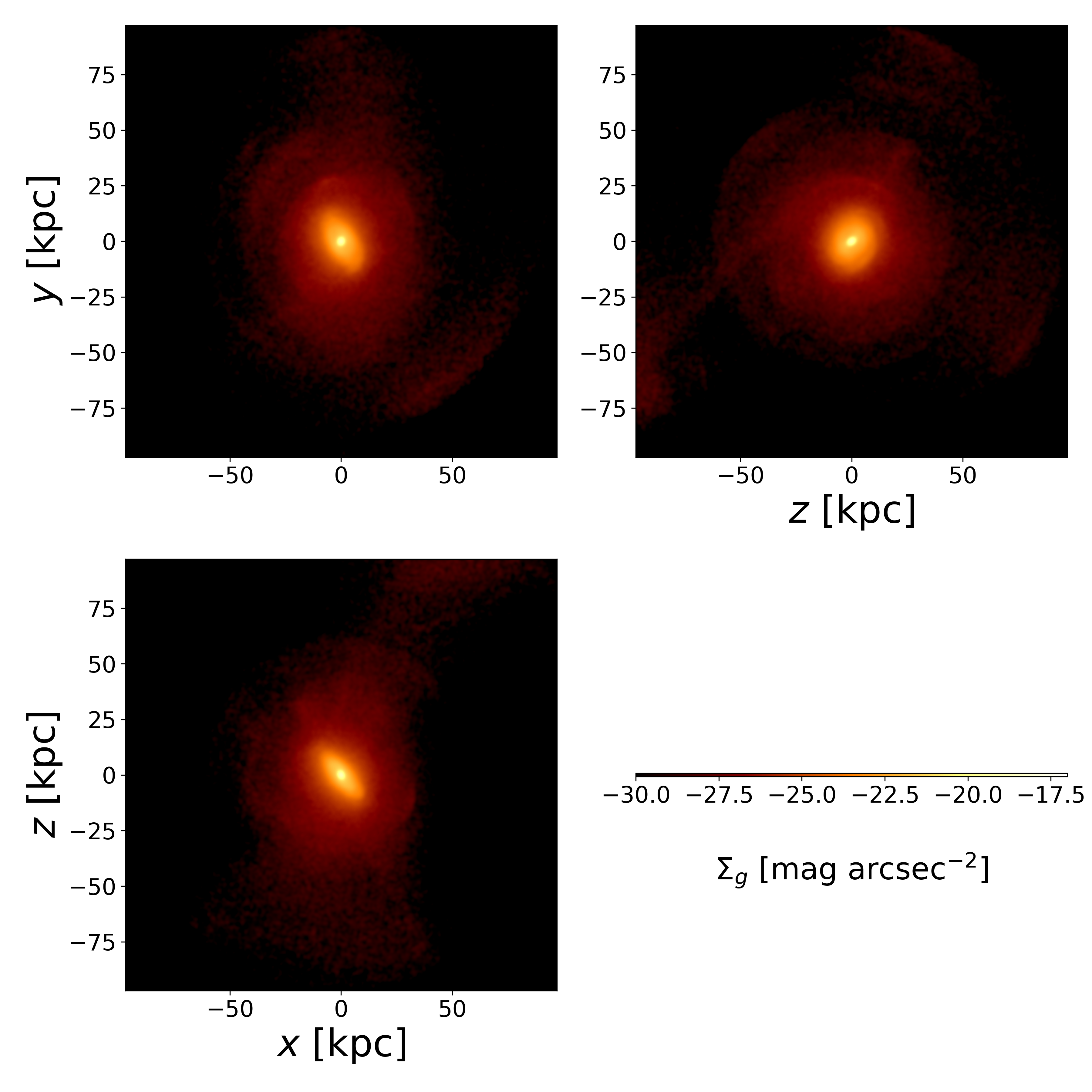
Using the Illustris TNG50 hydrodynamic cosmological simulation, a view of the galaxy from the x, y and z axes was obtained.


The 511920 galaxy is viewed from the x-y, x-z and y-z axes. The scaling is magnitude per arsec^2.