

Mergers and stellar kinematics of ETGs in cosmological simulations and observations

Ivana Ebrova 1 , Michal  Bílek 1,2,3 , Ana  Lalović 4 , Mustafa K.  Yıldız 5,6 , Pierre-Alain Duc 7 , Michael Prouza 1

  • 1 FZU – Institute of Physics of the Czech Academy of Sciences, Prague
  • 2 LERMA, Observatoire de Paris, CNRS, PSL Univ., Sorbonne Univ., Paris
  • 3 Collège de France, 11 place Marcelin Berthelot, Paris
  • 4 Astronomical Observatory, Belgrade, Belgrade
  • 5 Astronomy and Space Sciences Department, Science Faculty, Erciyes University, Kayseri
  • 6 Erciyes University, Astronomy and Space Sciences Observatory Applied and Research Center (UZAYBIMER), Kayseri
  • 7 Université de Strasbourg, CNRS, Observatoire astronomique de Strasbourg (ObAS), Strasbourg

Abstract

Modern advances in astrophysics allow us to examine various phenomena on statistically significant samples of galaxies on both sides of the alley — simulations model the evolution of baryonic matter in large volumes in the cosmological context, and observational surveys provide spatially resolved spectroscopy as well as ultra-deep images of a large number of galaxies. We combine the knowledge of all those fields while investigating kinematic features of early-type galaxies (ETGs), namely prolate rotation (i.e. rotation around the long axis) and kinematically distinct cores (KDCs).

We showed that, in the Illustris simulations, both features differ in mass distribution of the host galaxies as well as in the relative importance of formation channels. Even though both can arise in a merger, KDCs can more often have other origins, and if their origins are associated with mergers, the mergers can be minor or ancient, while basically all massive prolate rotators were created in quite recent major mergers. Such mergers are expected to produce tidal features (tails, shells, asymmetric stellar halos) that should be visible in sufficiently deep images.

The frequency of tidal disturbance that we found in deep optical images of prolate rotators proved to be of a high statistical significance when compared with a general sample of ETGs. Using the Milankovic telescope (Astronomical Station Vidojevica), we completed the sample of all 27 known nearby massive prolate rotators with deep images. The most common tidal features among the prolate rotators are stellar shells. We developed a procedure that allows us to estimate the time of the merger for shell galaxies and compare the estimate with the predictions of the Illustris simulation. We will proceed with even larger samples of shell galaxies that will provide important information on the recent merger history of our Universe and allow extensive investigation of the impact of mergers on a wide range of other astrophysical phenomena.

Features in ETGs

A large portion of early-type galaxies (ETGs) harbor interesting features that tell us about the past evolution of their hosts. 
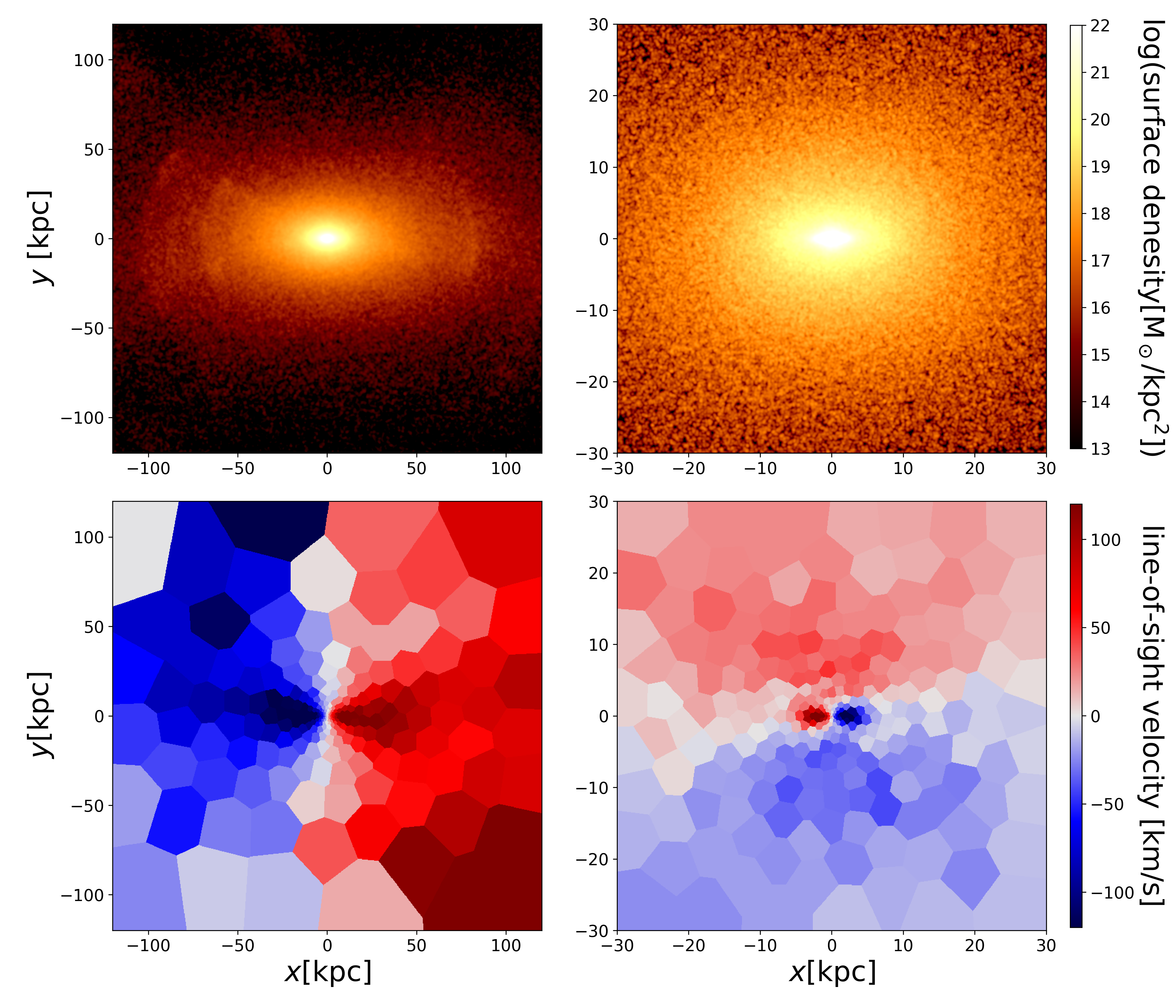
Surface density (top row) and kinematics (bottom row) of stellar particles of two galaxies from the Illustris simulation. Left column: galaxy with a normal disky rotation and with stellar shells visible in the top panel. Right column: galaxy with prolate rotation and a kinematically distinct core.

In our previous work (Ebrová & Łokas 2017 and Ebrová, Łokas, & Eliášek 2021), we examined kinematic features of ETGs in the Illustris cosmological simulation and found that prolate rotation (e.i. rotation around the major morphological axis) in massive ETGs originates in relatively recent major mergers. 


We examined available deep optical images of known prolate rotators and found signs of galaxy interaction in all of them (Ebrová et al. 2021), which proves to be a statistically very significant correlation when compared with a general sample of ETGs in MATLAS — a deep imaging survey (Duc et al. 2015, Bílek et al. 2020).
Complete Sample

In our current project, we assembled deep optical images of the complete sample of all 27 known nearby massive prolate rotators (Ebrová et al. 2024).

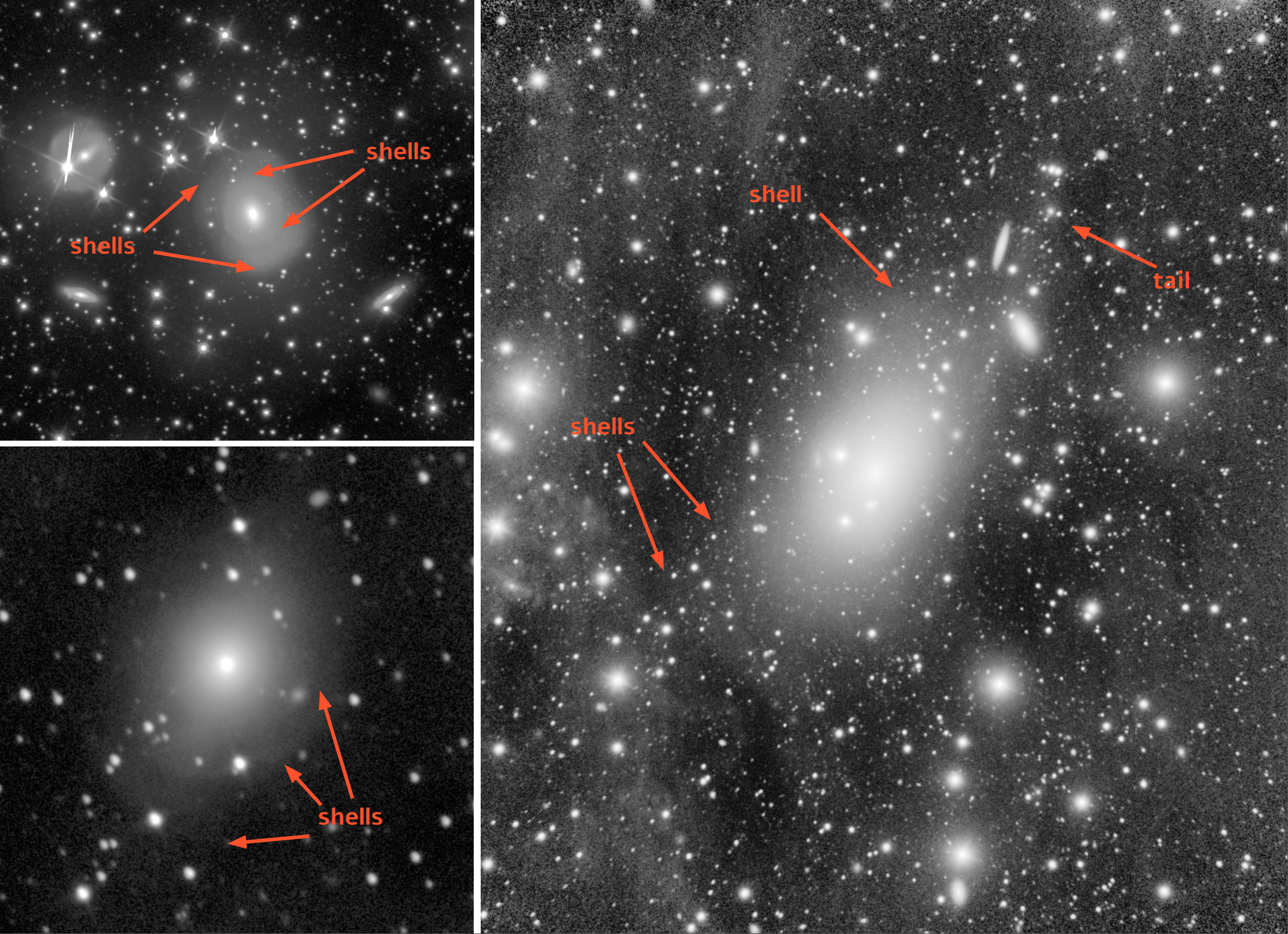
Recent deep images of three prolate rotators from the Milanković telescope.

We used the Serbian 1.4m Milanković telescope at the Astronomical Station Vidojevica to assemble sufficiently deep images of all additional prolate rotators, each with at least 5.5 hours integrated on-source exposure time in the L-band. All but one (NGC 7052, see the next panel) show signs of galaxy interactions when processed in a way to be comparable with our reference sample of the MATLAS survey. 

Hidden Tidal Features

NGC 7052 is a special case of a prolate rotator. 

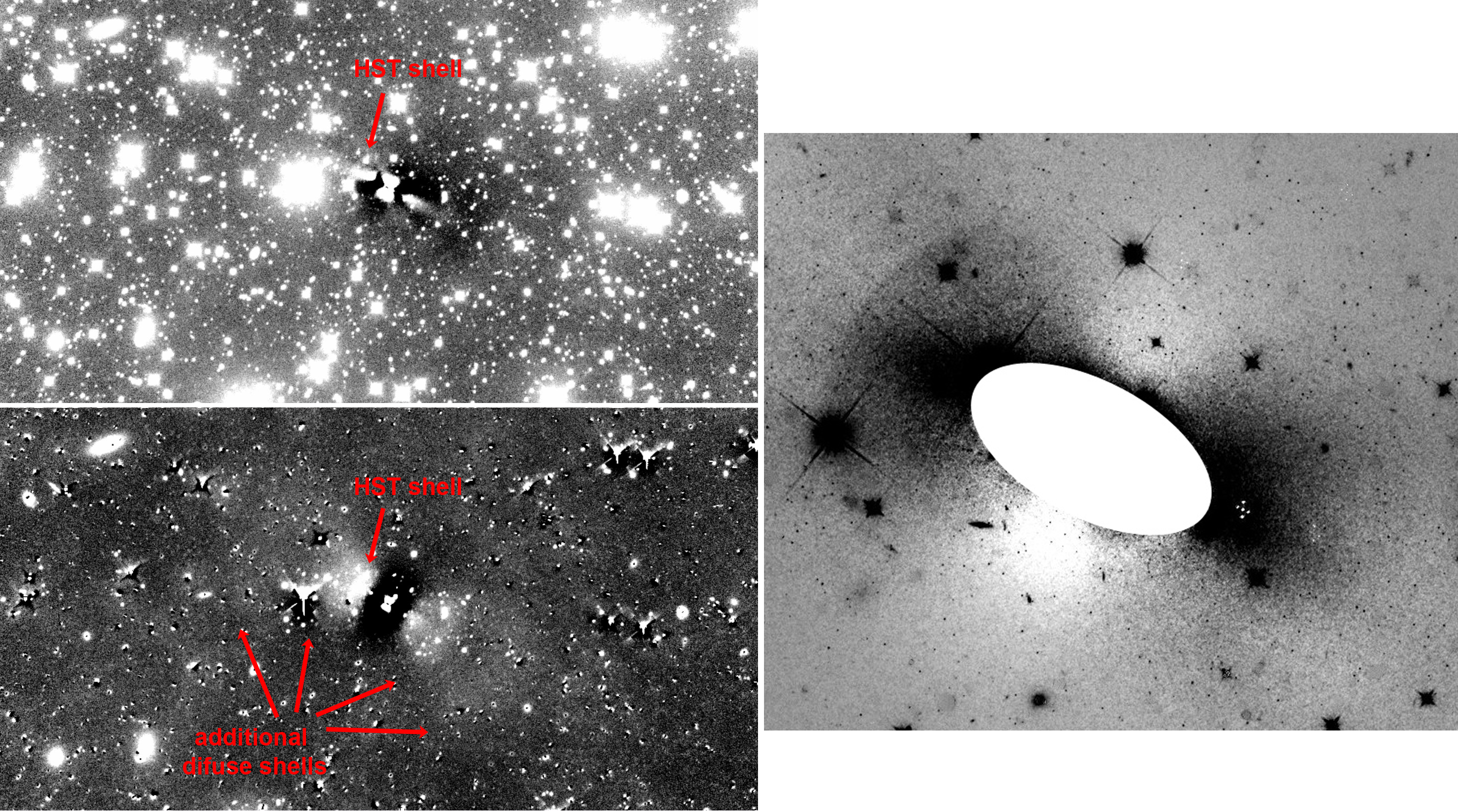
Processed, model-substraced images of NGC 7052 from the Milanković telescope (left) and HST (right).

NGC 7052 is the only prolate rotator that does not show interaction signs in images comparable with MATLAS. The Hubble Space Telescope (HST) observed inner parts of the galaxy and revealed a sharp shell (see the right panel of the figure) which is not visible in MATLAS-like images. The shell is disguised even in deep images from ground-based telescopes, probably because of its relatively small size and low contrast. 

Using GALFIT on the data from the Milanković telescope, we modeled the host galaxy light with a Sérsic profile and subtracted it from the image. This procedure uncovered the HST shell, see the left panels of the figure.

The next step is to subtract stars with a customized procedure created by Michal Bílek. Such an image reveals even more subtle shells around the host galaxy, see the bottom left panel of the figure. This is crucial as a multiple-shell system allows us to estimate the time since the galaxy merger (e.g. Ebrová et al. 2020, Bílek et al. 2014). With all the tidal features uncovered, we will be able to estimate the merger time for a large portion of our sample of prolate rotators, creating a complex picture of their evolution.


Acknowledgements

This project has received funding from the European Union's Horizon Europe Research and Innovation programme under the Marie Skłodowska-Curie grant agreement No. 101067618-GalaxyMergers.


Disclaimer: Funded by the European Union. Views and opinions expressed are however those of the author(s) only and do not necessarily reflect those of the European Union or European Research Executive Agency (REA). Neither the European Union nor REA can be held responsible for them.


References

Bílek, M., Bartošková, K., Ebrová, I., & Jungwiert, B. 2014, A&A, 566, A151 

Bílek, M., Duc, P.-A., Cuillandre, J.-C., et al. 2020, MNRAS, 498, 2138

Duc, P.-A., Cuillandre, J.-C., Karabal, E., et al. 2015, MNRAS, 446, 120

Ebrová, I., Bílek, M., Vudragović, A., Yıldız, M. K., & Duc, P.-A. 2021, A&A, 650, A50

Ebrová, I., Bílek, M., Vudragović, A., Yıldız, M. K., & Duc, P.-A., Mašek, M., Prouza, M. 2024, Proceedings of the XX Serbian Astronomical Conference, October 16-20, 2023, Belgrade, Serbia; Publications of the Astronomical Observatory of Belgrade; arxiv:231205532

Ebrová, I., Bílek, M., Yıldız, M. K., & Eliášek, J. 2020, A&A, 634, A73   

Ebrová, I., & Łokas, E. L. 2017, ApJ, 850, 144

Ebrová, I., Łokas, E. L., & Eliášek, J. 2021, A&A, 647, A103