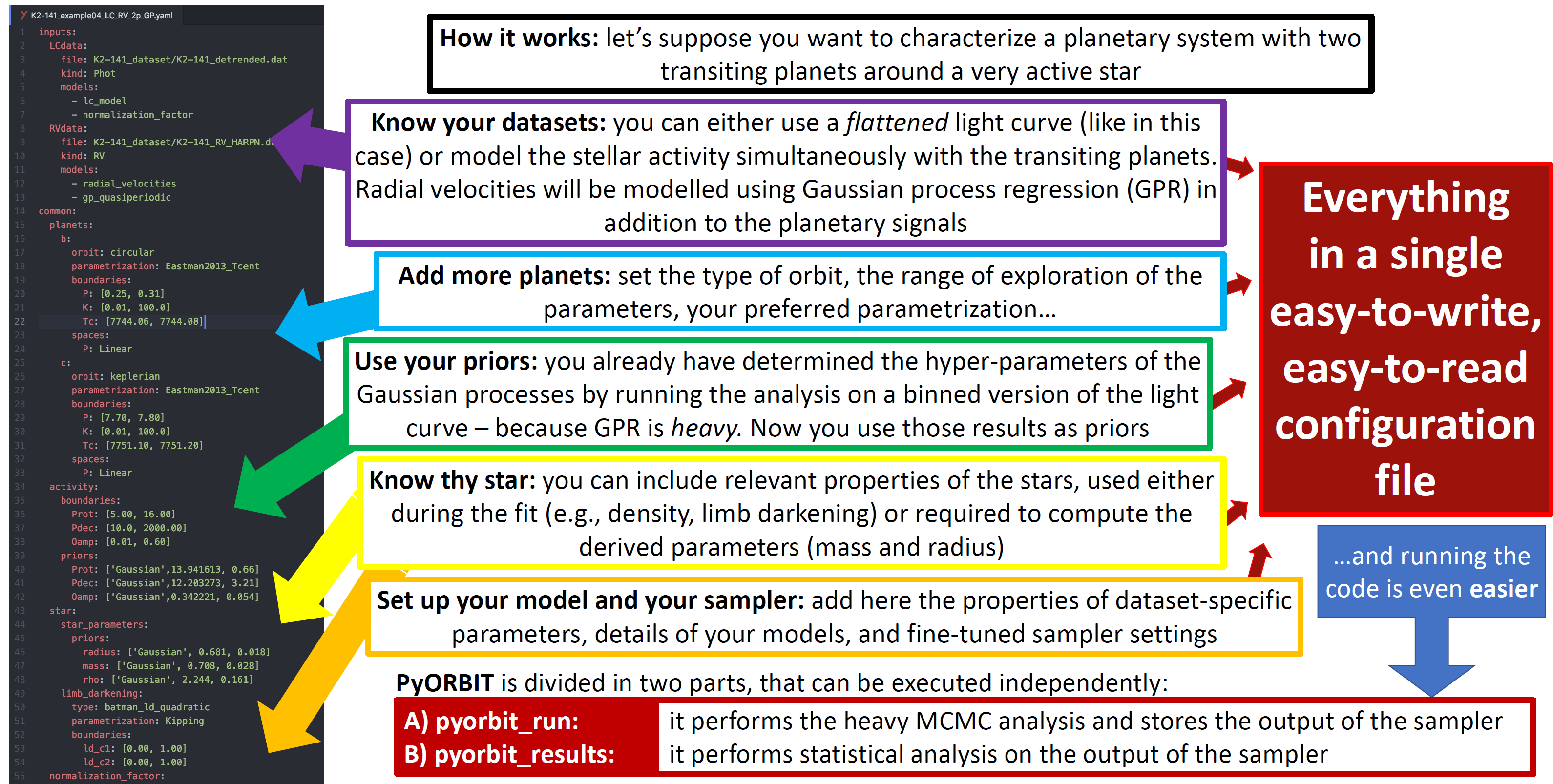

PyORBIT is a robust, versatile framework for the characterization of planetary systems.
With PyORBIT you can model light curves (LC), radial velocities (RV), activity indexes (AI), and transit time variations (TTV)
Advanced modelling options
Stellar activity modelling on radial velocity and light curves using Gaussian Processes
Rossiter-McLaughlin effect (Standard, Reloaded, Revolution)
Light curve fitting of multi-band/multi-instrument photometry, with independent dilution factors and out-of-transit normalizations
Lightcurve detrending using linear/exponential correlations with observational parameters
Simultaneous CHEOPS detrending and light curve fitting
Correlation between datasets
Sinusoids and Polynomial trends with independent or shared parameters across datasets
Sinusoids with polynomial modulation, with independent or shared parameters across datasets
Samplers
Priors
Gaussian, Half (Positive/Negative) Gaussian, Jeffreys and Modified Jeffreys, truncated Raileigh, White Noise, Beta Distribution
All available for both MCMC and Nested Sampling
Additional Features
Parameter exploration in Linear or Logarithmic (base 2 / base 10) space (your choice)
Several parameterizations for eccentricity, argument of periastron, limb darkening…
Predisposition to run as a script for planet population studies