
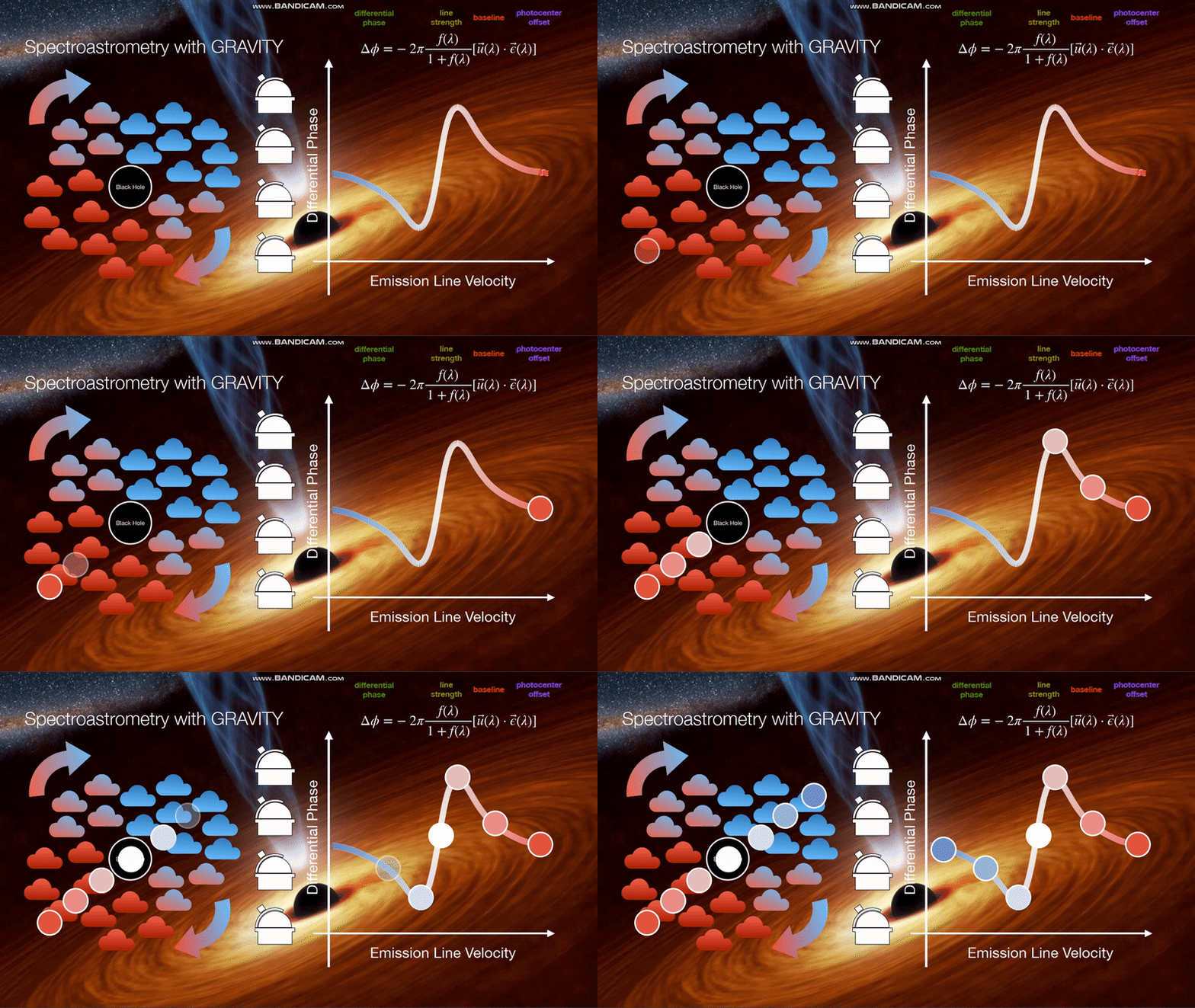
Fig. 1. An animation showing how the differential phase is related to the photocentre shift of the broad-line region (BLR) emission. The equation on the upper right corner of the figure shows how the differential phase is calculated as a function of line strength, baseline projection, and photocentre offset.
GRAVITY and differential phase
- The GRAVITY instrument operates in the K-band (near-infrared) and combines the light of the four unit telescopes (UTs) at the Very Large Telescope Interferometer (VLTI) to conduct interferometric observations.
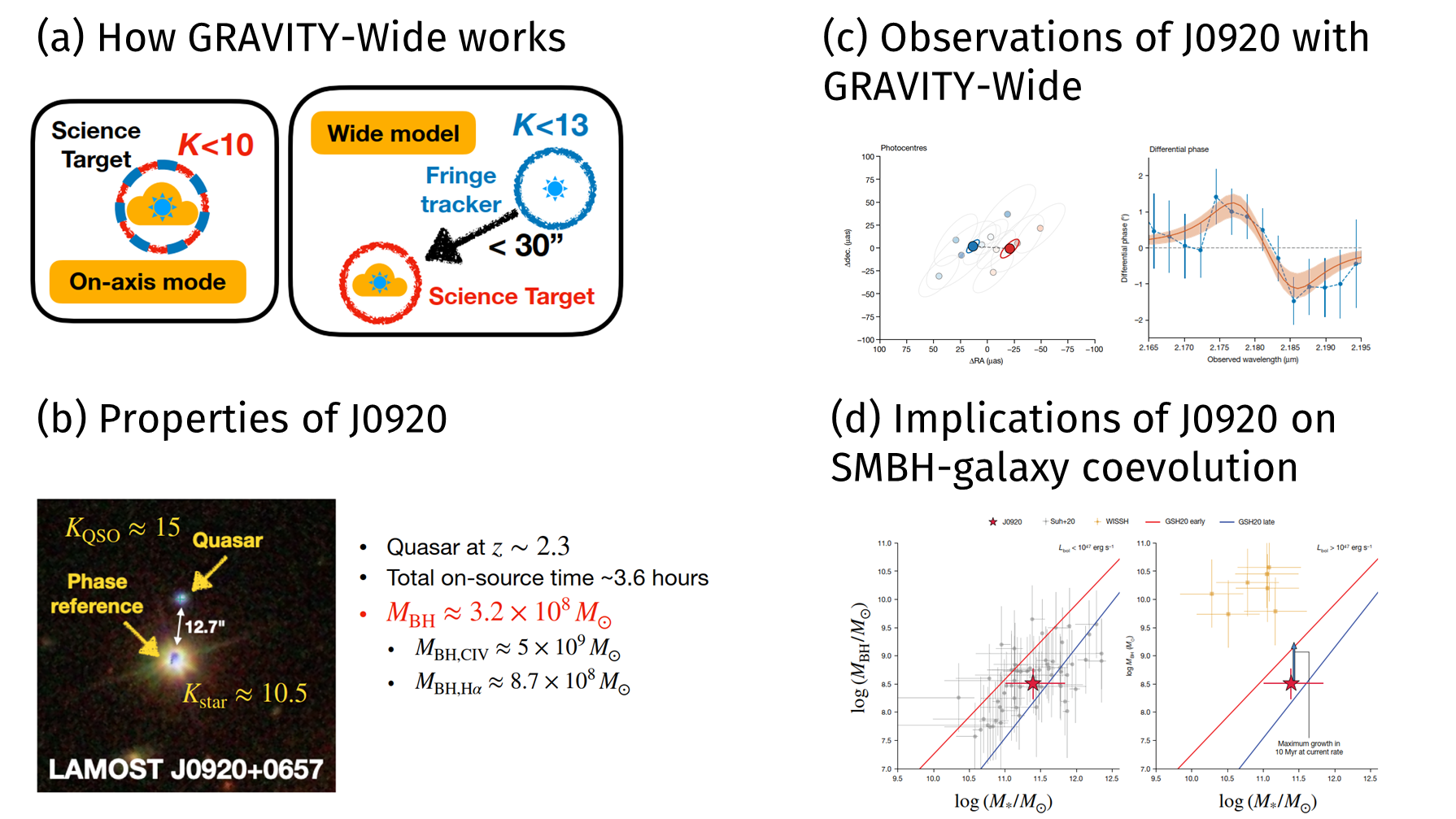
- The differential phase (Δφ) measures the photocentre shift of the broad-line emission on the sky at different wavelength channels with respect to the continuum emission.
- A rotating structure normally exhibits an S-shaped differential phase signal that is also centred on the observed central wavelength of the emission line.
GRAVITY+
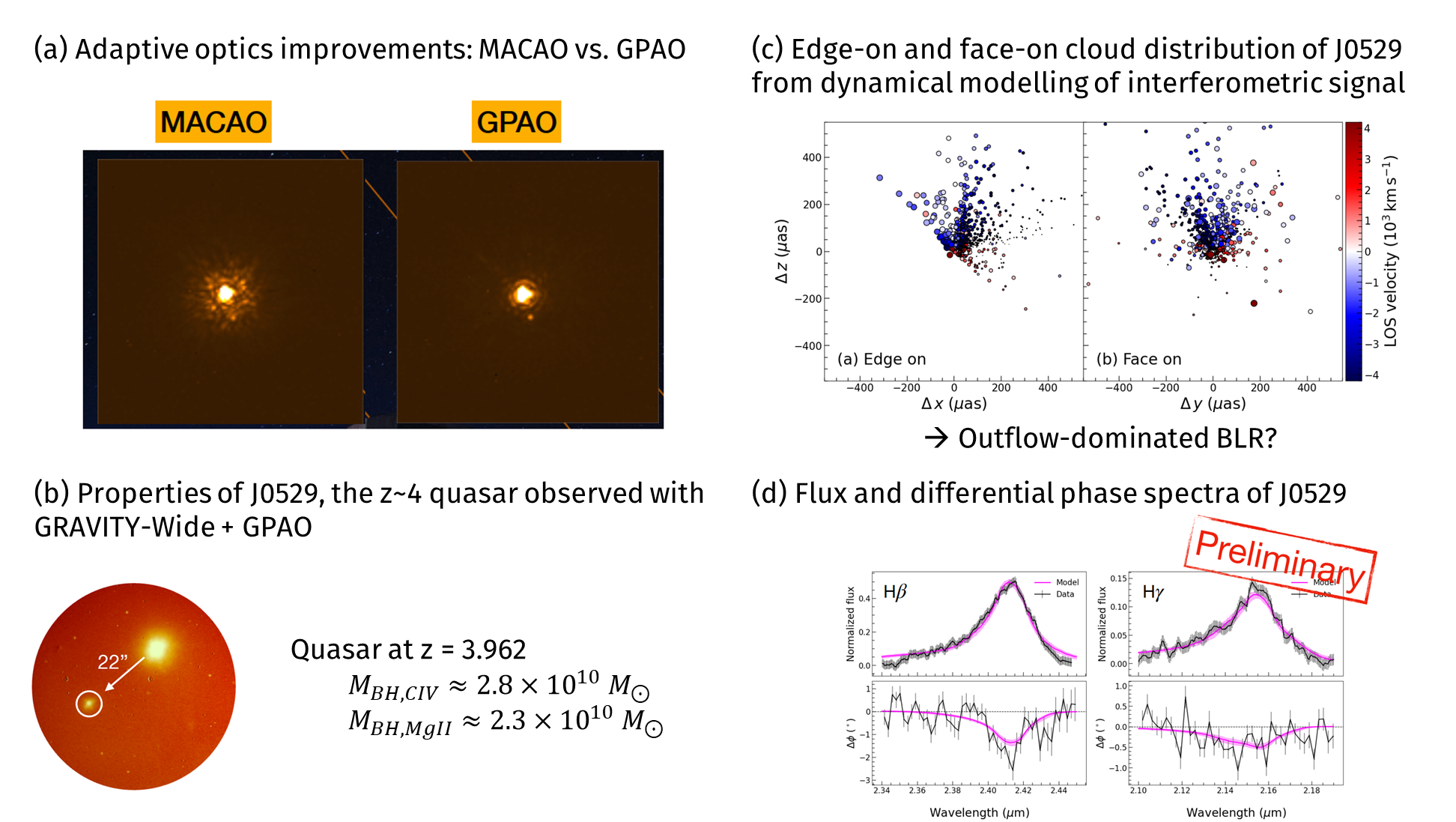
- GRAVITY+ is comprised of a series of upgrades on GRAVITY and VLTI (Fig 2a), which will greatly improve the sensitivity and sky coverage of GRAVITY (Fig 2b).
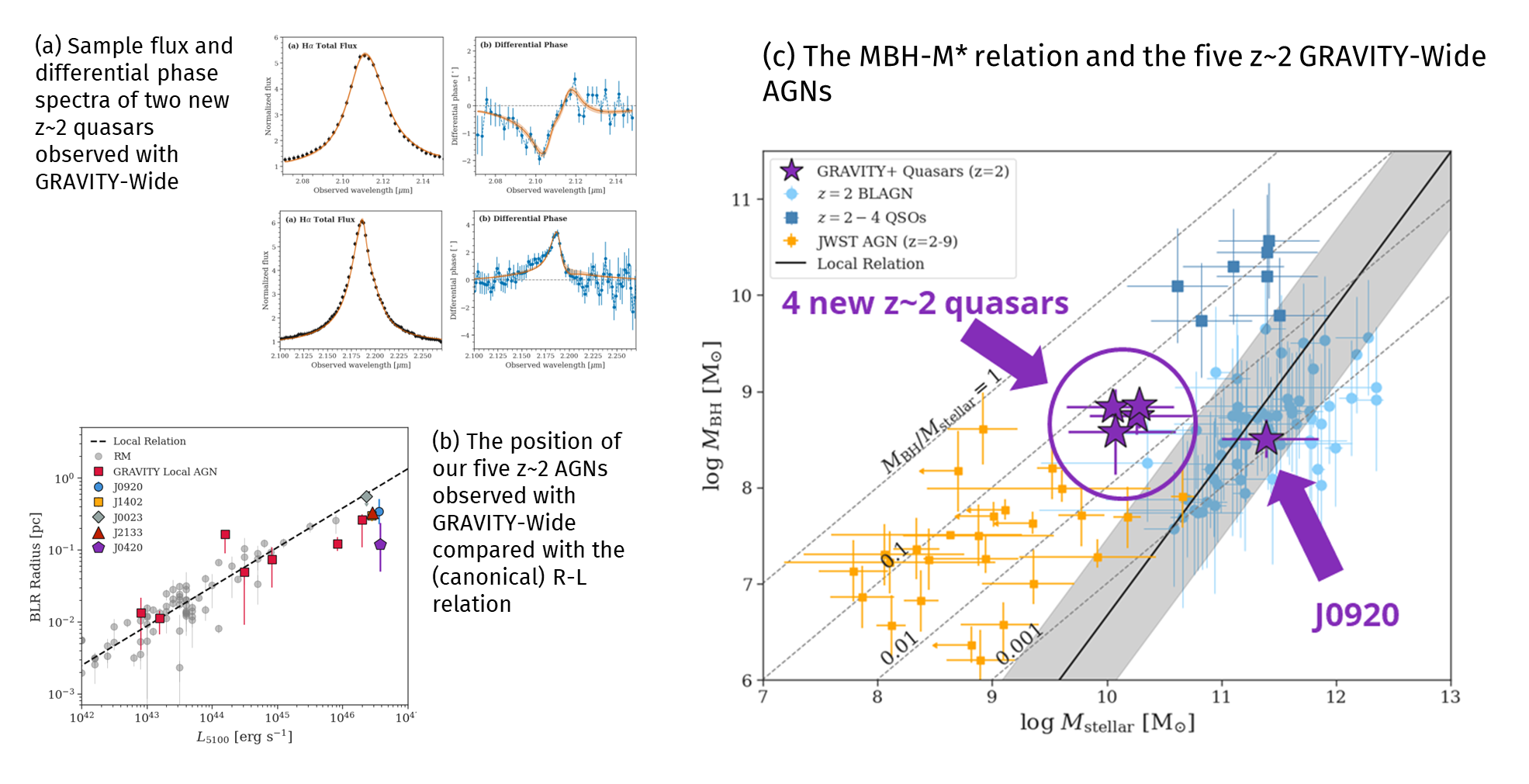
- With GRAVITY+, we expect to extend our work from observing several tens of low-redshift AGNs up to hundreds of faint, high-redshift AGNs, especially at cosmic noon (1 < z < 3), when the star formation and black hole accretion histories have peaked (Madau & Dickinson 2014).
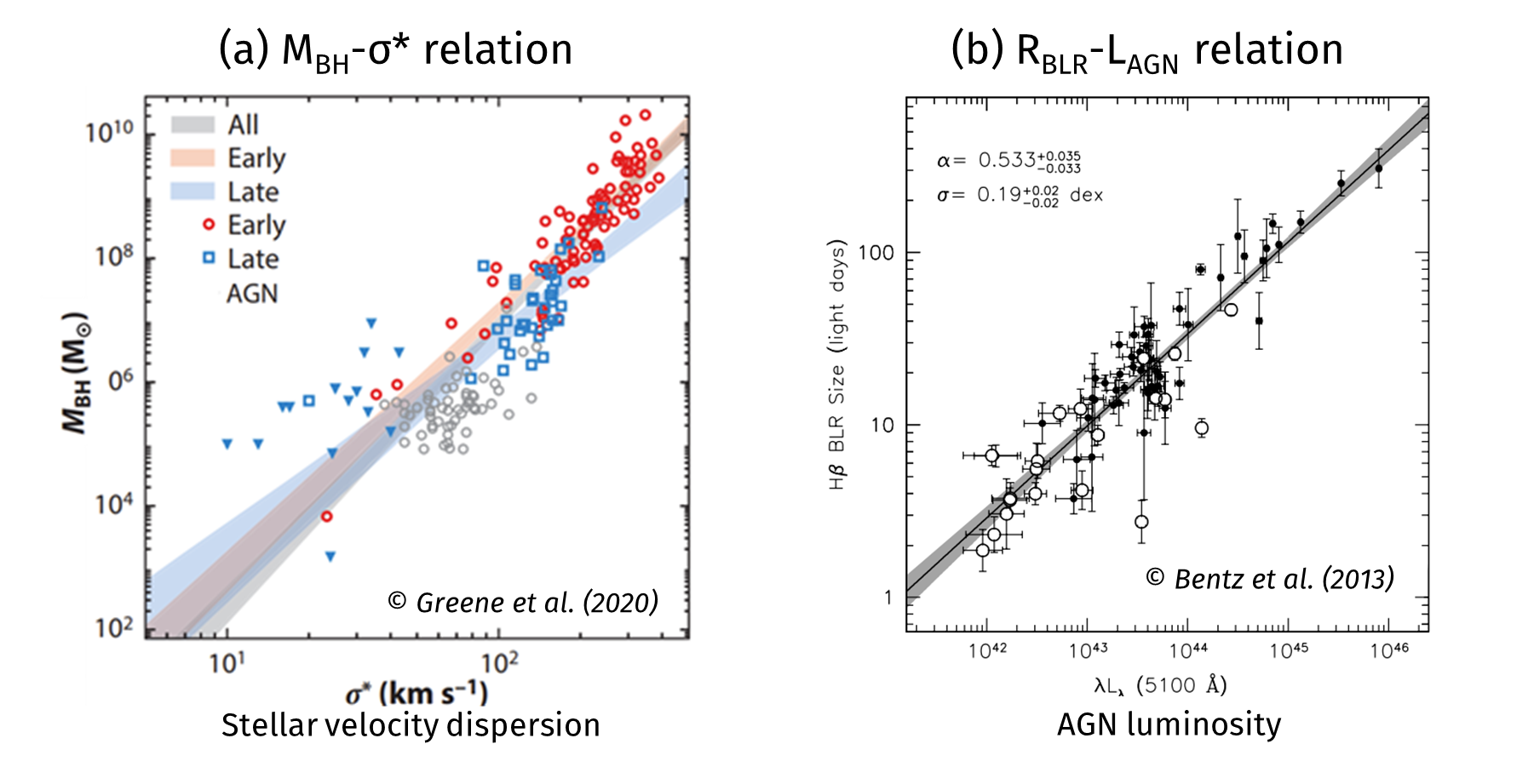
- This will allow us to probe the redshift evolution of AGN scaling relations and the overall picture of SMBH-galaxy coevolution across cosmic time.
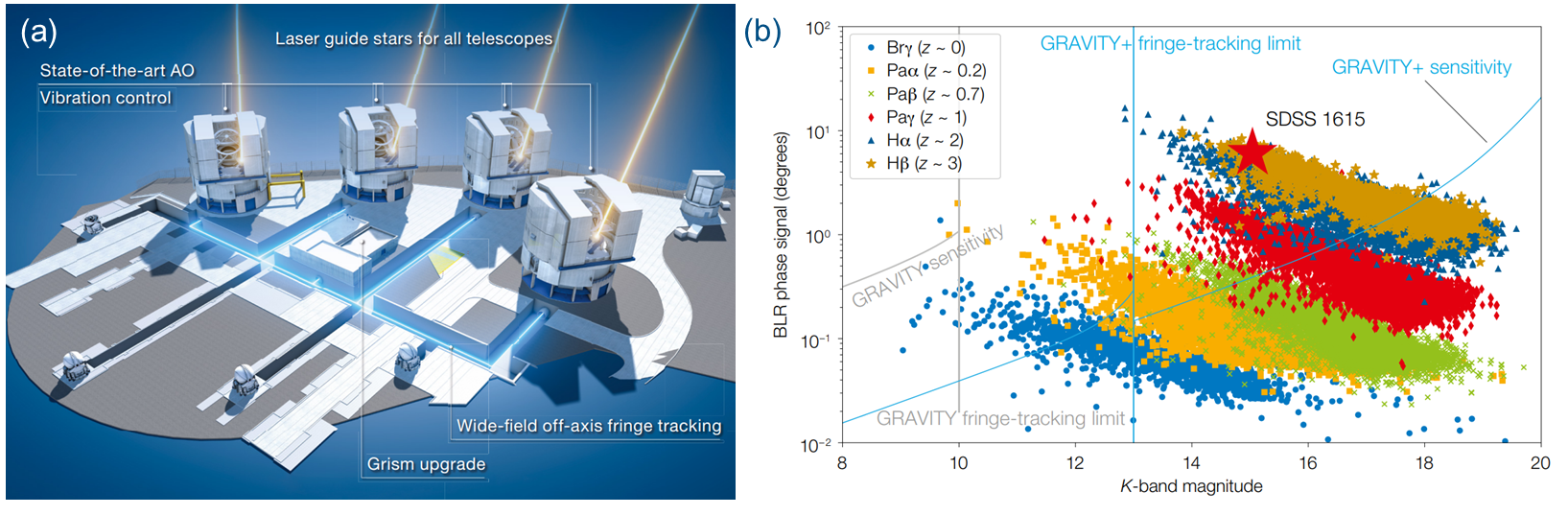
Fig 2. (a) A schematic diagram showing the different improvements in VLTI/GRAVITY to produce GRAVITY+; (b) A scatterplot showing the BLR differential phase signal in degrees of several quasars that could be observed with GRAVITY as a function of their K-band magnitude. Different colours pertain to different Balmer lines that can be observed with GRAVITY, which operates in the K-band. The sensitivity curves of GRAVITY and GRAVITY+ are shown as grey and blue curves, respectively, while their fringe tracking limits are shown as grey and blue vertical lines, respectively. The plot highlights the improvement in the sensitivity of GRAVITY+, allowing fringe tracking of stars as faint as K ~ 12.5 mag and observations of AGNs as faint as K ~ 18 mag. SDSS J0920, the first z~2 quasar observed with GRAVITY, is highlighted as a red star. Taken from Abuter+22.