Temperature-Pressure Profile
"Free" Profile
"Physical" Profile
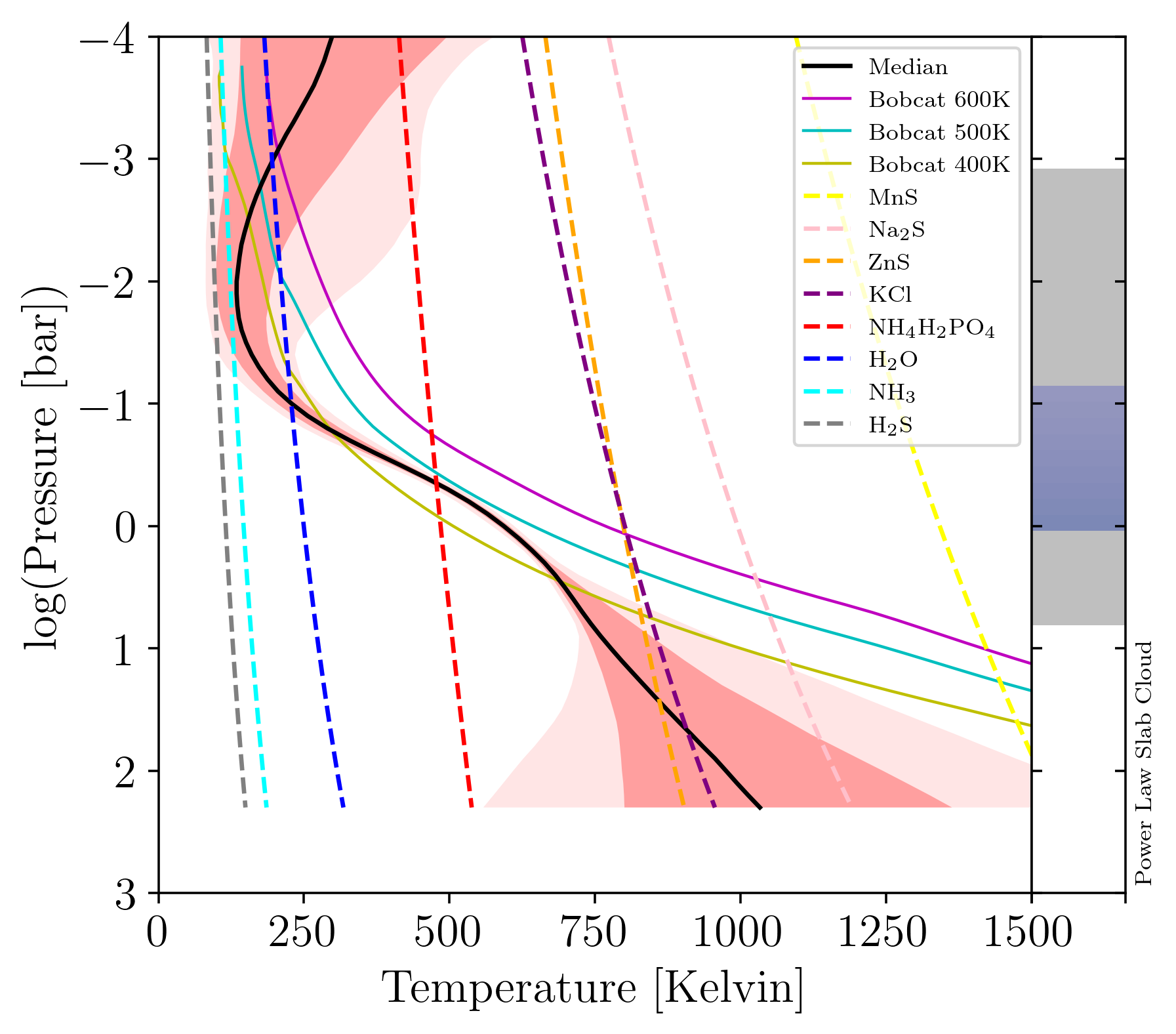
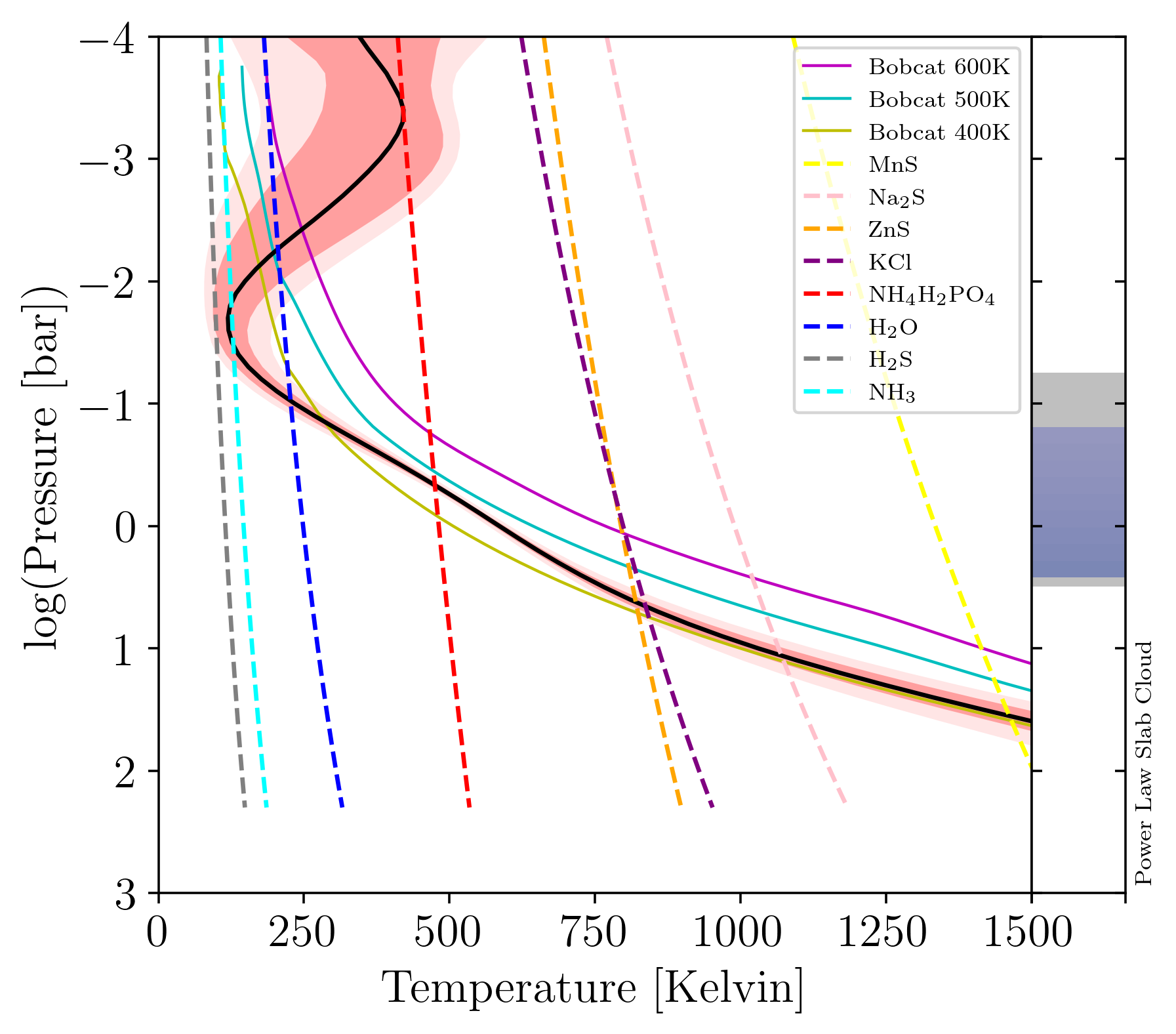


⋆ All models exhibit a 'kink' - introducing a cloud does not wholly explain the 'kink'.
⋆ All the models fit the data, except the "physical" profile introduces spurious methane emission.
⋆ A direct comparison between models with different temperature-pressure profiles is difficult due to different numbers of parameters that affect the BIC values.
All the gas abundances were well-constrained except for CH3D and PH3, for which we have 3σ upper limits instead.
Very low mass brown dwarfs are often differentiated from exoplanets based on the deuterium burning limit of ~13 MJ. Planets should retain their deuterium, whilst brown dwarfs will have burnt the majority.
We want to know if our unconstrained CH3D abundance is due to either an absence of deuterated methane in the atmosphere of Coconuts-2b or if the level of CH3D present in below the sensitivity level of Brewster.
We performed a signal insertion test, replacing the retrieved value of CH3D with the Jovian abundance and performed the "free" clear atmosphere retrieval at the same signal-to-noise ratio as the G395H data, and then at double the signal-to-noise ratio.
.png)
The Jovian abundance is well constrained at double the signal-to-noise ratio of the G395H data, so we need 4 times the number of incident photons to detect CH3D.
.png)
All the retrieved values of 12CO/13CO for the models are enriched in 13CO in comparison to the ISM (12C/13C)ISM = 68 ± 16 (Langer & Penzias 1993, Milam et al. 2005).
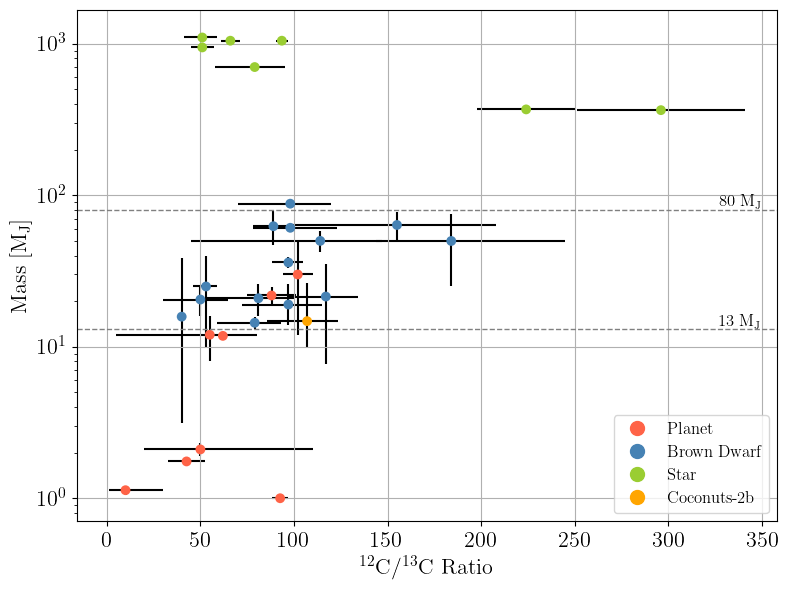
Plot of carbon isotopologue values from available literature, colour coded in terms of object type: planet, brown dwarf or star. There is no clear division or trend between values for objects.
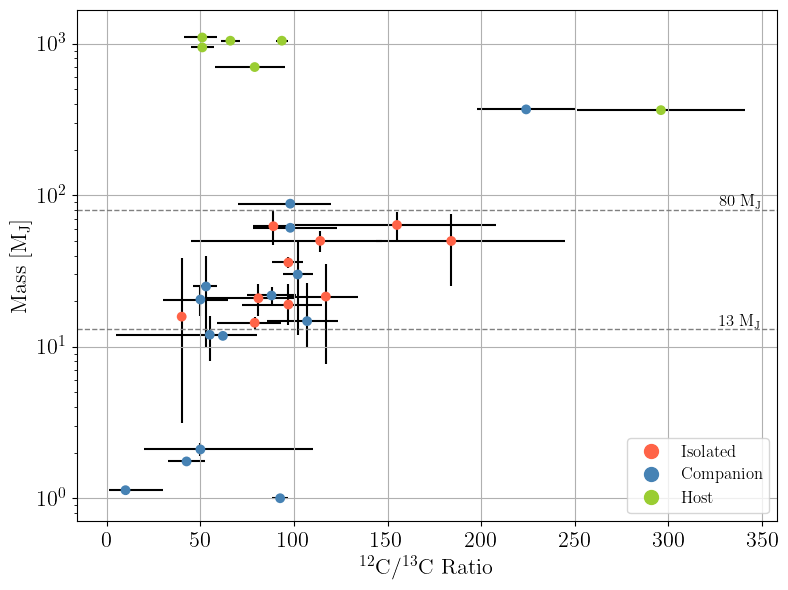
The same plot - but this time objects are colour coded according to whether they are isolated, a host or a companion,
As yet, with this sample size of measure values, there is no clear division of 12C/13C ratio between planets and brown dwarfs. The reasoning for this - the change in isotope for carbon in CO creates minimal effect. The major carbon-bearing molecules like CO, CH4, and CO2 all contain only one carbon atom. So, detecting 12C versus 13C versions doesn’t involve complex isotopic fractionation across multiple atoms.
The Brewster retrieval framework parameterises to a really high level - not just temperature and log g, but in each level of atmosphere (Burningham et al. (2017, 2021); Gonzales et al. (2020); Gaarn et al. (2023)).
The user starts by setting parameter ranges initialisations. These parameters may include...
Then the retrieval framework then sets up the priors based on the initialisations.
.png)
We ran retrievals for two temperature-pressure profiles across a clear atmosphere and an atmosphere with a power law slab cloud. The description for the set-up of these within Brewster is described below...
Here, we test two temperature–pressure profiles:
On the right is a visualisation of the "physical" profile.
.png)
We assume non-equilibrium chemistry and independently retrieve abundances for 9 gases: H2O, 12CH4, 12CH3D, 12CO and 13CO, CO2, NH3, H2S and PH3. Opacities for these are sampled at R = 30,000.
As well as a clear atmosphere, we test a wavelength-dependent power law slab cloud. The cloud model requires two aspects of parameterisation:
The slab cloud is parameterised by: cloud top pressure (Ptop); the thickness of the cloud (Δ logP); total optical depth at 1 μm (τ0) and the power index (α).
.png)
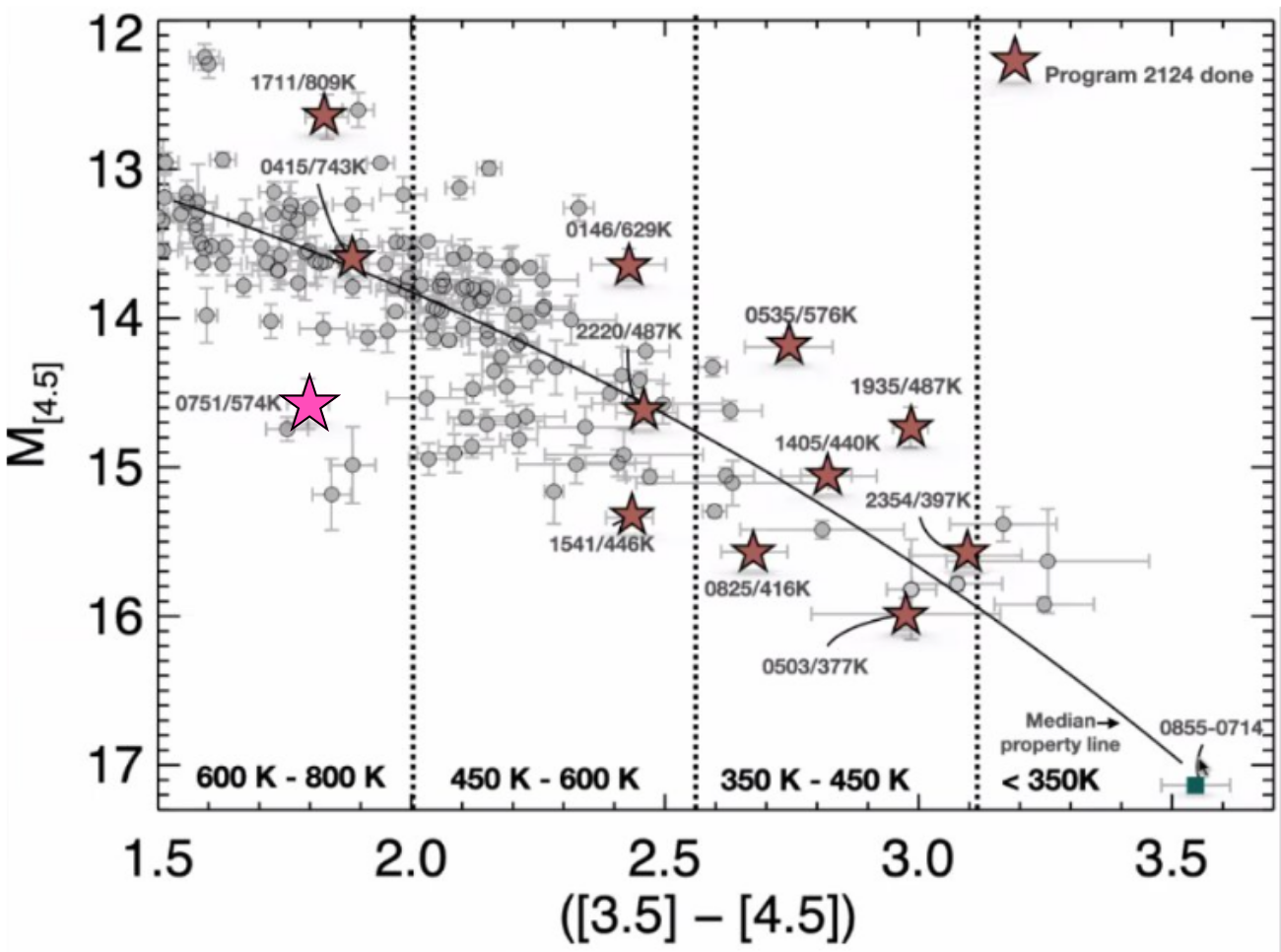
Coconuts-2b was observed by the James Webb Space Telescope (JWST) as part of Cycle 1 GO program 2124 (PI Faherty). Targets were chosen on the basis of their Spitzer mid-infrared colours across four colour bins aiming to represent changing temperatures from 800 K to < 350 K.
Coconuts-2b was of interest due to being in orbit around a host star along with its unusually blue colour.
In this work we analyse the NIRSpec G395H spectrum of Coconuts-2b, which covers the wavelength range 2.87 to 5.14 𝜇m with a resolving power of ∼2700.
Situated ∼10 pc away, the system consists of the host star Coconuts-2A, a solar-like M3V dwarf star (Torres et al. 2006), with Coconuts-2b, a T9-type object, orbiting at a separation of ∼6471 AU (Kirkpatrick et al. 2019; Zhang et al. 2021).
.png)
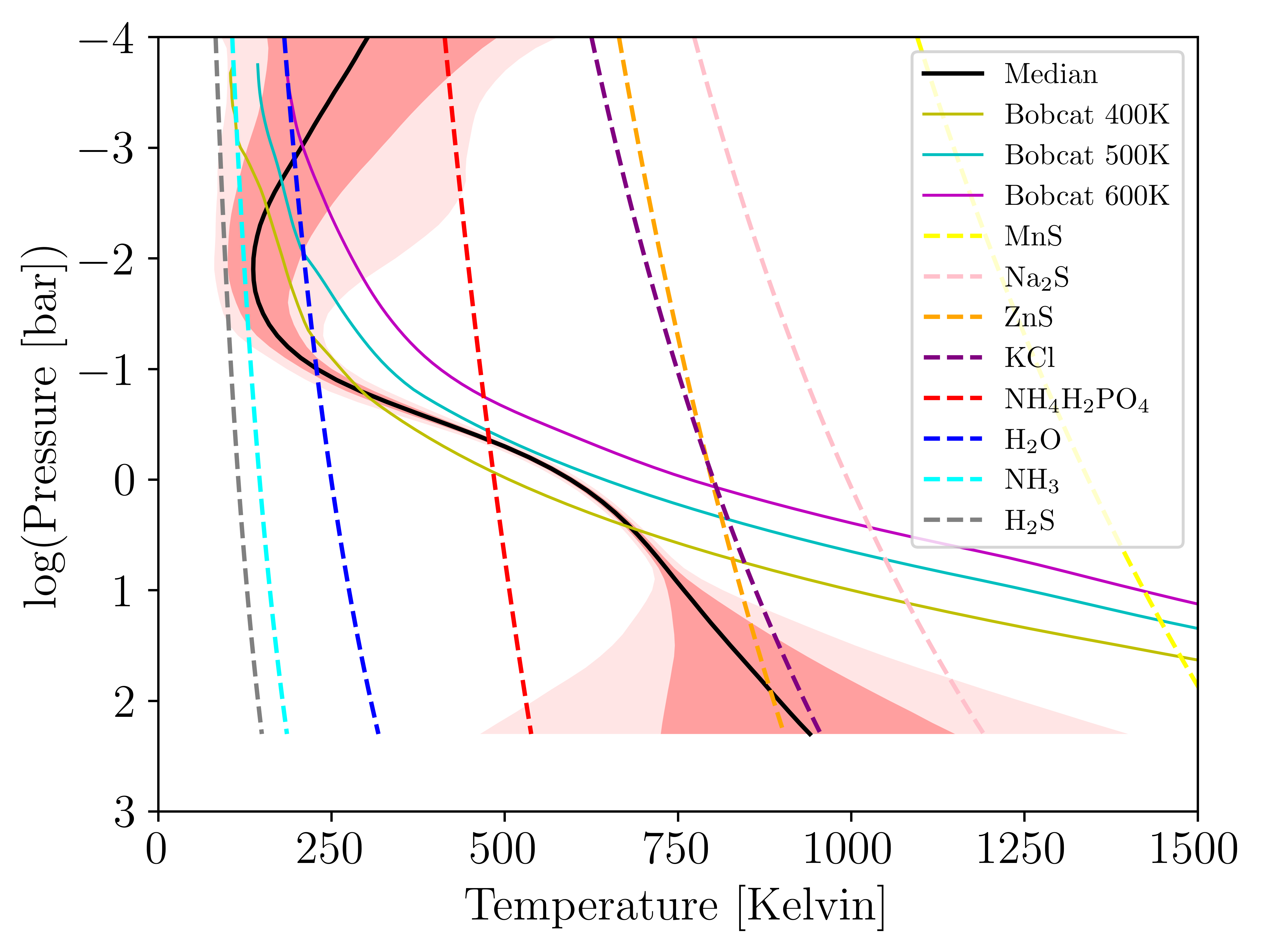
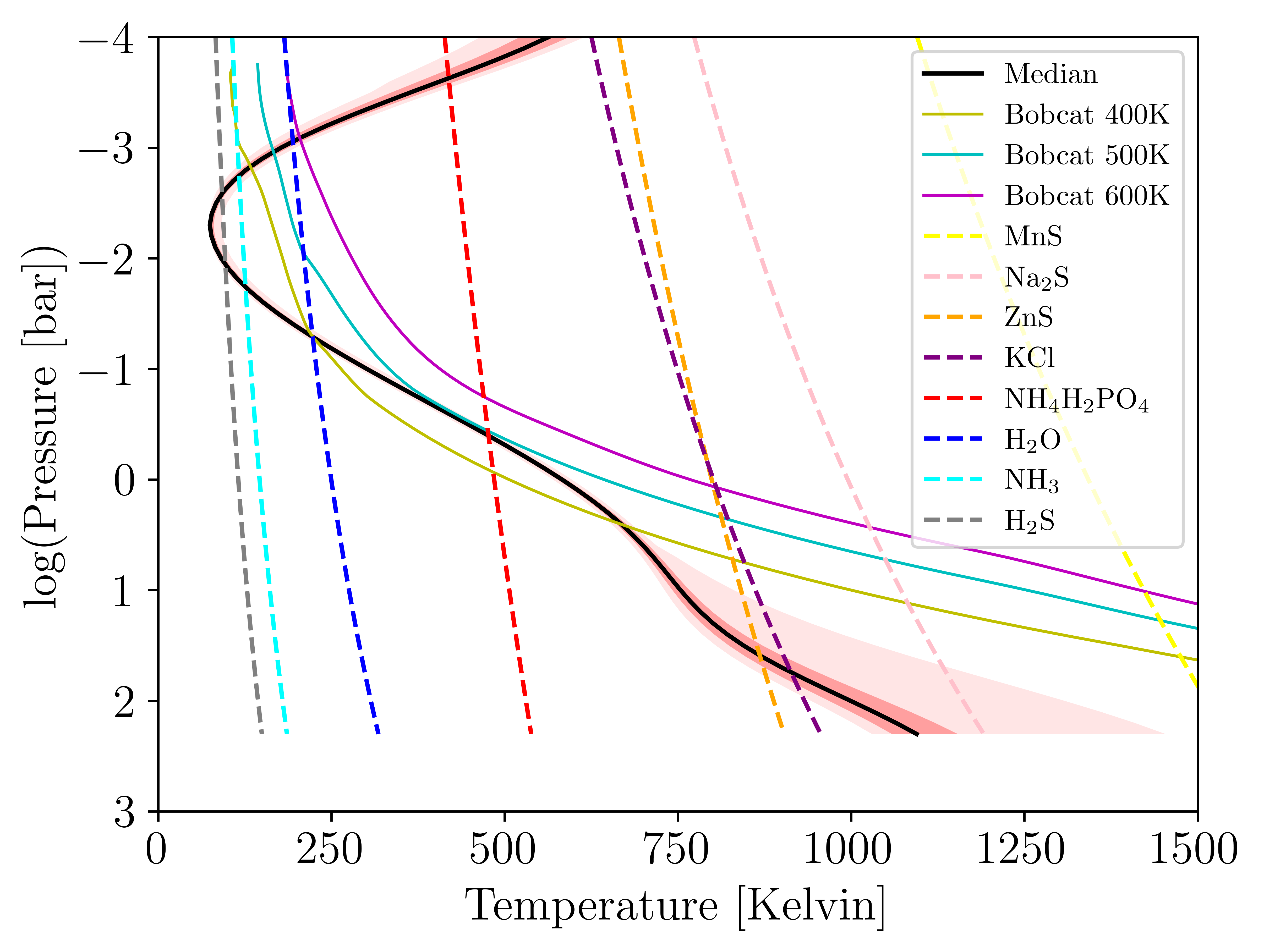
The retrieved temperature-pressure profiles for the "free" and "physical" profiles. Dashed lines are condensation curves for potential cloud species - where a species could condense but not that it will condense. The solid coloured lines are the Sonora Bobcat grid model predictions for log g = 4.0 and solar metallicity.
For the "free" profile we can see a 'kink' and a divergence in the deeper atmosphere from the adiabat predicted by the grid models. Instead we see more isothermal behaviour. Even the "physical" profile which encourages an adiabat cannot completely avoid this behaviour.
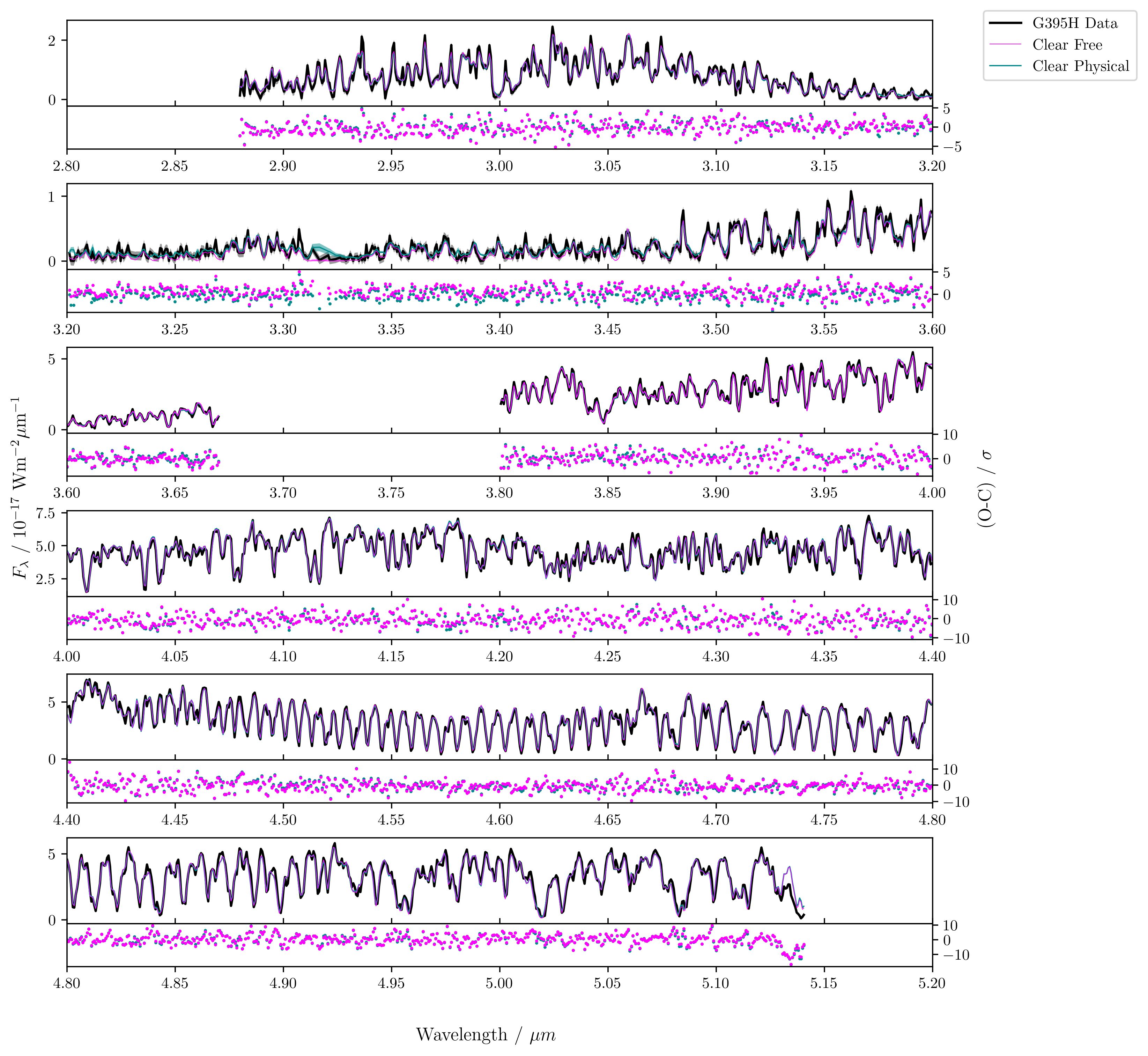
The G395H spectrum (in black) along with the median retrieved spectra for the "free" ( in magenta) and "physical" (in cyan) clear atmosphere models. Residuals are also plotted, showing the models have similar quality fit except for the spurious emission introduced at 3.4 𝜇m by the "physical" model.
⋆ Atmospheric retrievals performed on a NIRSpec spectrum of T9 object Coconuts-2b show a 'kink' in the temperature-pressure profile at around 500 K - addition of a cloud does not wholly explain this.
⋆ We find 3𝜎 upper limits for deuterated methane (CH3D), but double the signal-to-noise ratio of the G359H data would be needed to constrain a Jovian abundance of CH3D.
⋆ 12C/13C isotopologue ratio shows no clear difference between ISM, planets, brown dwarfs and stars.