Fornax3D project: A Census of the PNe population in the early-type galaxies in Fornax.

Thomas Spriggs 1 , Marc Sarzi 2 , Ralf Napitwozki 1 , Pablo M. Galán-de Anta 3

  • 1 Centre for Astrophysics Research, Department of Physics, Astronomy and Mathematics, University of Hertfordshire,, Hatfield
  • 2 Armagh Observatory and Planetarium, Armagh
  • 3 Astrophysics Research centre, School of Mathematics and Physics, Queen's University Belfast, Belfast

Abstract

The study of Planetary Nebulae (PNe) in other galaxies offers a view into the late stages of stellar evolution in galactic environments that are considerably different compared to that of the Milky Way. For instance, the specific number of PNe is thought to depend on the stellar metallicity of their parent population at a given stellar age. Massive early-type galaxies provide a benchmark for studying PNe in a super-Solar metallicity regime for old stellar population, and in this respect, integral field spectroscopy offers a unique way to detect PNe against the bright stellar background their central regions. We use Fornax 3D Project MUSE to explore the PNe population of the brightest early-type galaxies within the Virial radius of the Fornax cluster.
Our catalogue of Fornax cluster PNe also includes, where possible, areas of the disk and halo regions, as observed during the Fornax3D survey (Sarzi et al. 2018). We developed and tested a novel 3D emission line fitting approach to the detection and cataloguing of extragalactic PNe, observed within Integral Field Unit (IFU) spectroscopic data. Our method is believed to be robust for nearly all areas of an extragalactic IFU observation. With it, PNe can be mapped out from the very central regions, reaching further out into the more expansive halo regions.
The results of the Fornax3D PNe catalogue includes the independently derived distances to each of the early type galaxies (ETG) covered in the F3D survey. They are in remarkable agreement with those distances from Surface Brightness Fluctuations (SBF, Blakeslee et al. 2009), along with other literature distances recorded for the Fornax cluster.

Article 1

Introduction
  • Planetary Nebulae (PNe) are bright beacons emitting ~103 Lʘ in [OIII] 5007 Å.
  • PN luminosity function (PNLF) can be used as a distance indicator.
  • Previous PNe studies mostly focused on outer halo regions of galaxies.
  • Yet, central regions are advantageous when deriving galaxy distances as they hold large number of PNe.
  • Large PNe number also helps in understanding the link with their parent stellar population.
  • Buzzoni (2006) found link between stellar metallicity and UV flux with abundance of PNe, but compared halo PNe populations with central stellar population measurement.
  • MUSE allows to simultaneously study PNe and stellar population properties, within the same spatial regions.
Methods
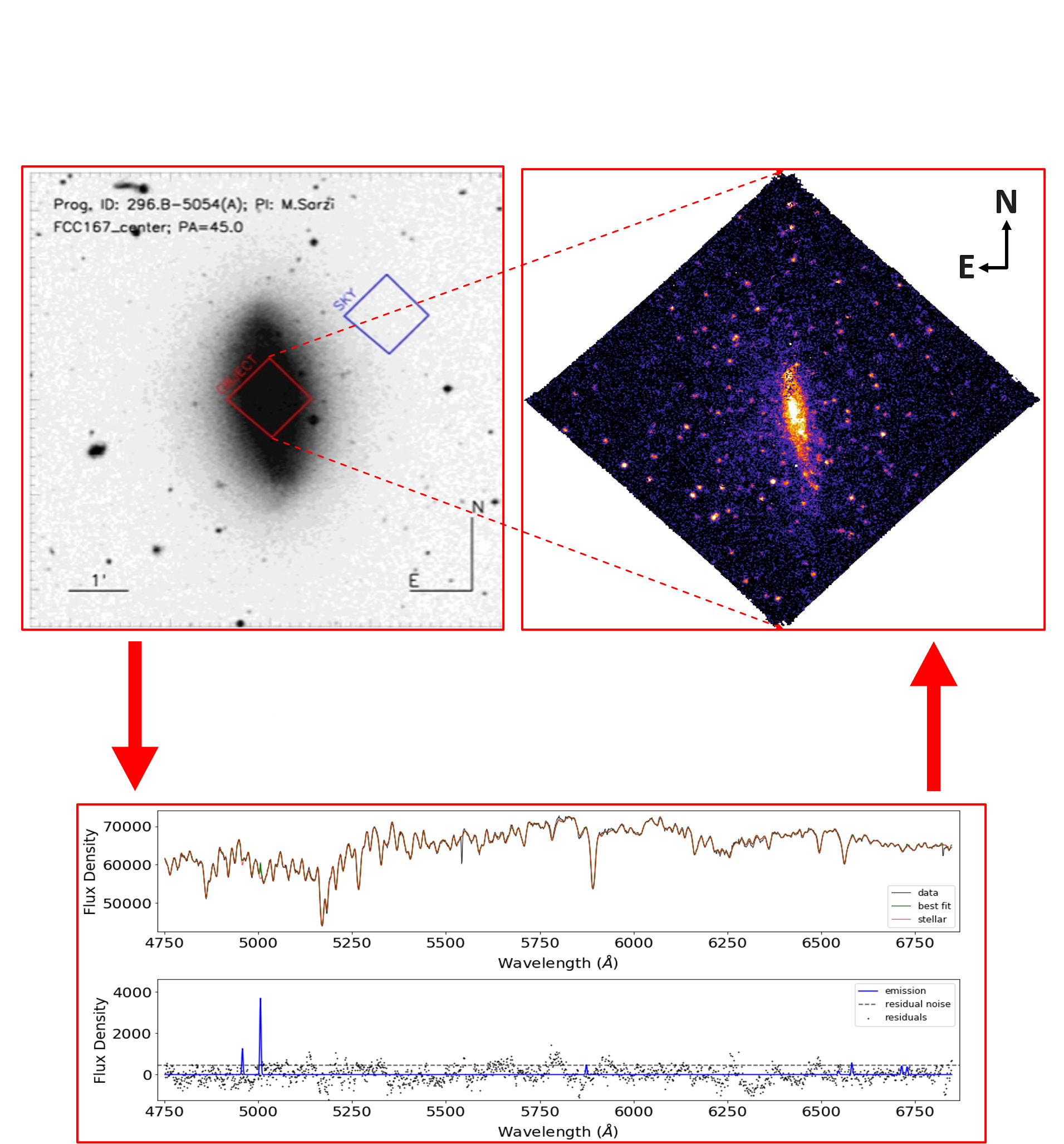
  • Model and subtract stellar continuum from MUSE data  (see right hand side figures).
  • Search for bright, unresolved point sources in [OIII] 5007 Å.
  • Catalogue PNe [OIII] 5007 magnitudes (m5007) via combination of spatial and spectral flux modelling; novel 3D PSF modelling.
  • Derive independent distances measurements from the completeness corrected PNLF, along with luminosity specific PNe frequency (α).
Discussion
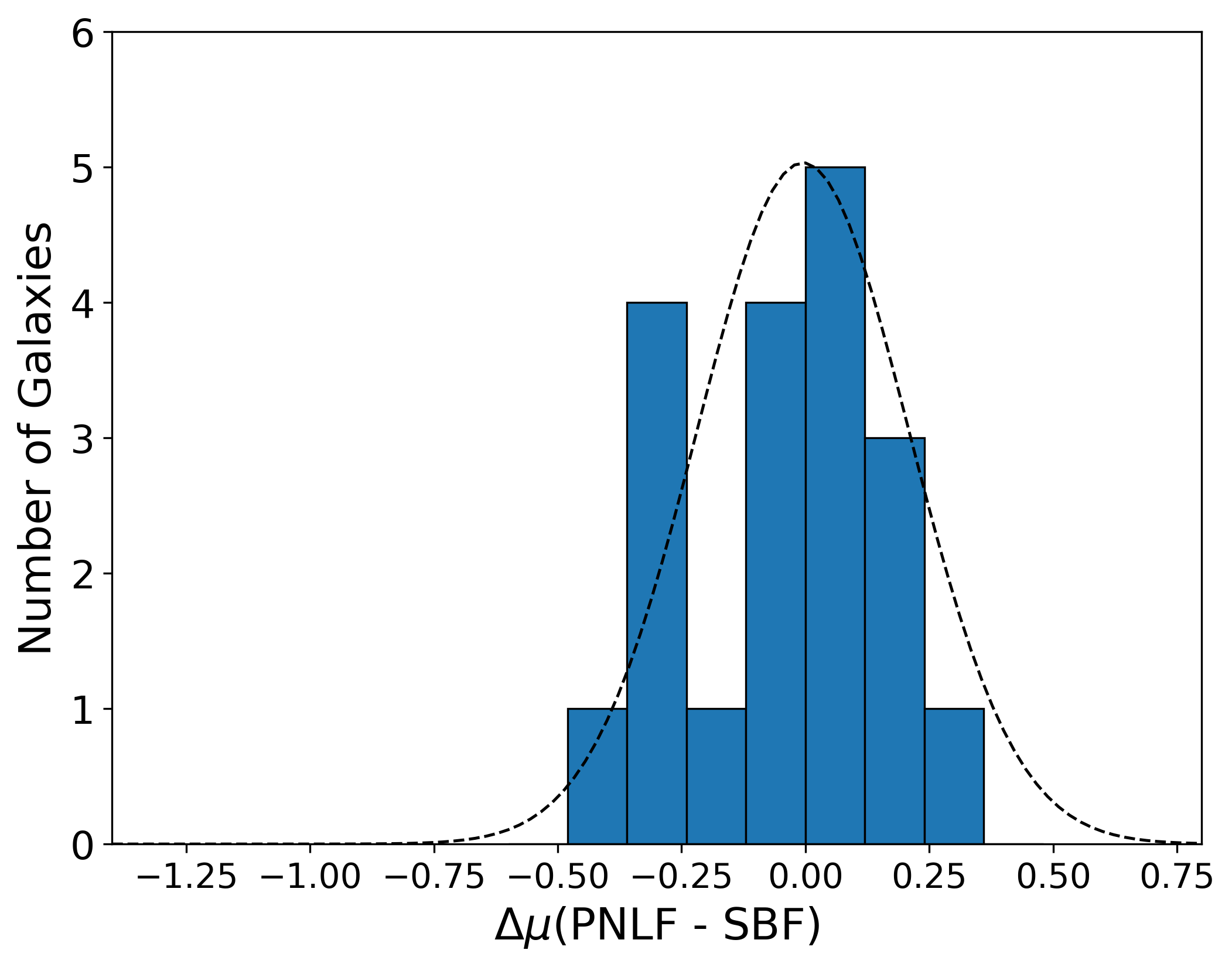
  • PNLF independent distance in great agreement with SBF and other methods.
  • Preliminary comparisons of central PNe with central:
  • metallicity shows a slight correlation: 
    • Higher metallicity → fewer PNe per Lʘ.
    • FUV-NUV shows slight correlation (see bottom right):  higher FUV → fewer PNe per Lʘ.
  • What could cause these higher values in FUV and metallicity?
    • Increased stellar metallicity leads to more Extreme Horizontal Branch (EHB) stars forming.
    • HB stars bypass the PNe phase, and head straight to the White Dwarf track. 
    • EHBs then contribute to FUV emissions for longer, increasing overall FUV flux.
Future Prospects
  • Simulations predict that MUSE Adaptive Optics (AO) observations will benefit PNe detections within distant galaxies: 40-60 Mpc
  • AO will also reveal more, fainter PNe than previously detected within non-AO observations, helping to understand the PNLF.

Article 2

1350 Planetary Nebulae catalogued over 21 Early Type Galaxies (ETGs) within the Fornax cluster.

PNLF derived distance to Fornax cluster:

19.90 ± 0.32 Mpc,

(Spriggs, T. W. et al. in prep)

PNLF derived distances vs Surface Brightness Fluctuations values. (Blakeslee, et al. 2009)

Article 3

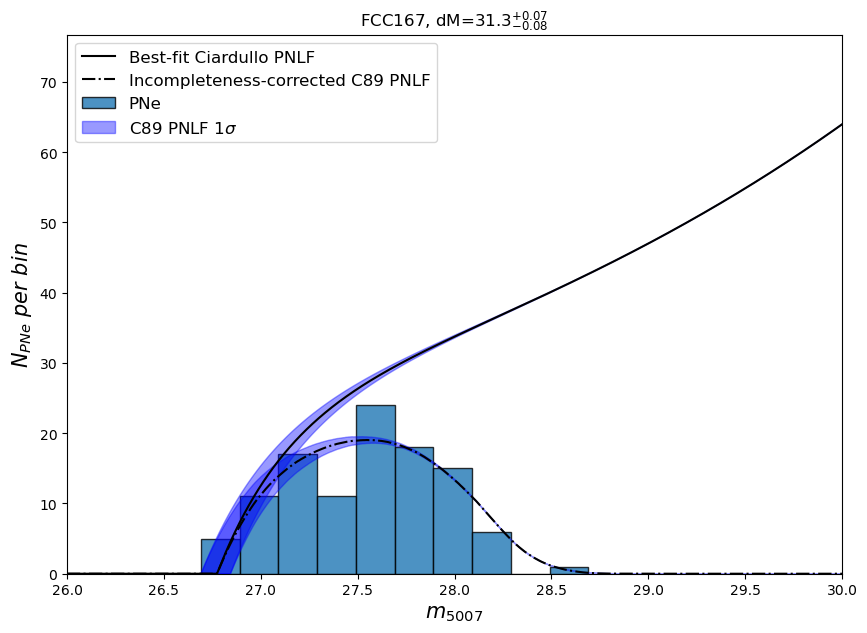
PNLF of FCC167, showing Ciardullo (1989) form, alongside the completeness corrected form.


DPNLF = 18.23 ± 0.65 Mpc

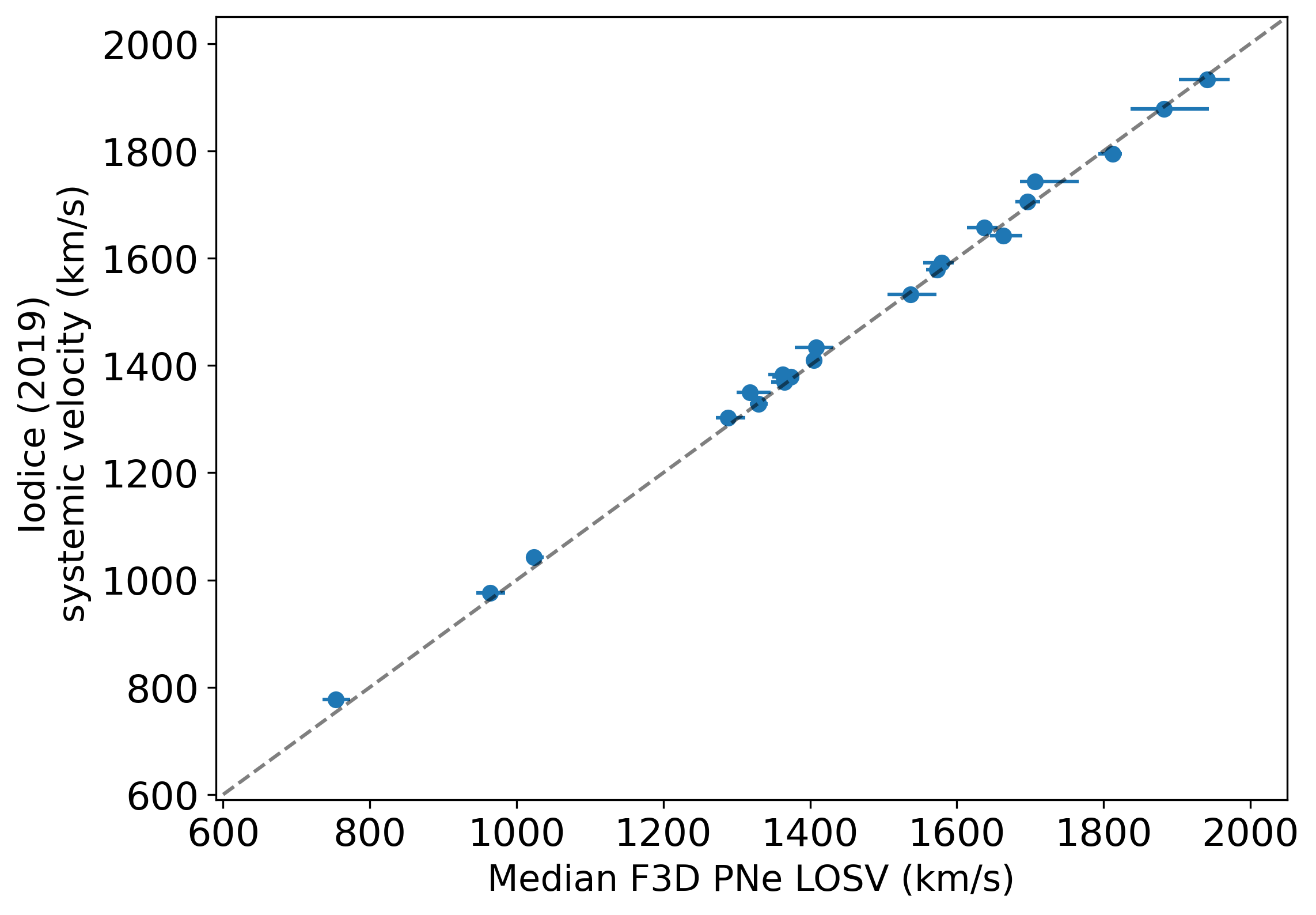
Median Line of Sight Velocity for each galaxy, derived from the PNe of the F3D data, compared to the reported stellar measured, systemic velocity of Iodice et al. (2019)