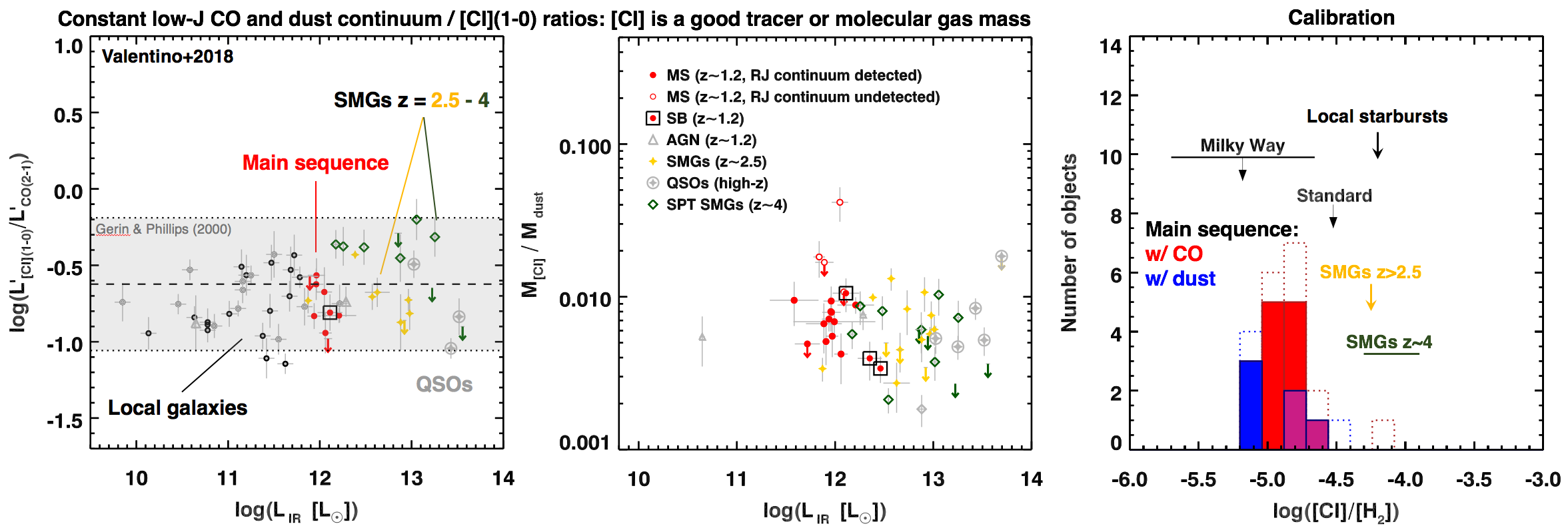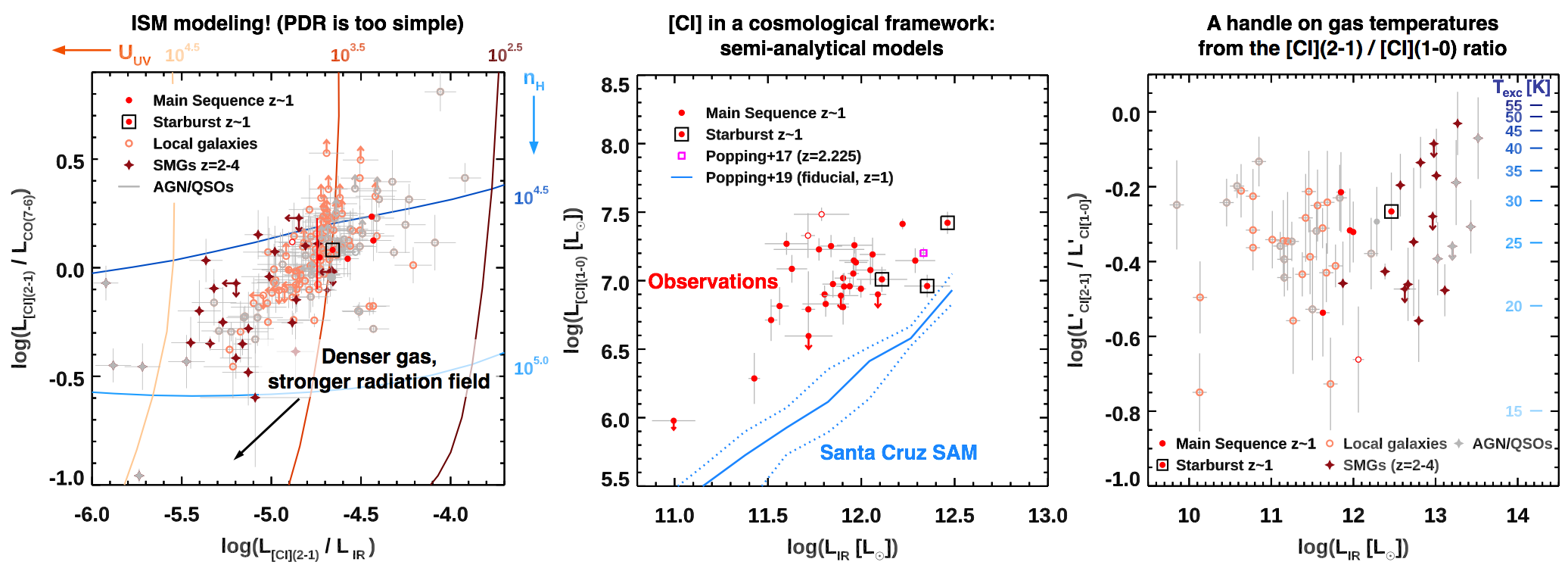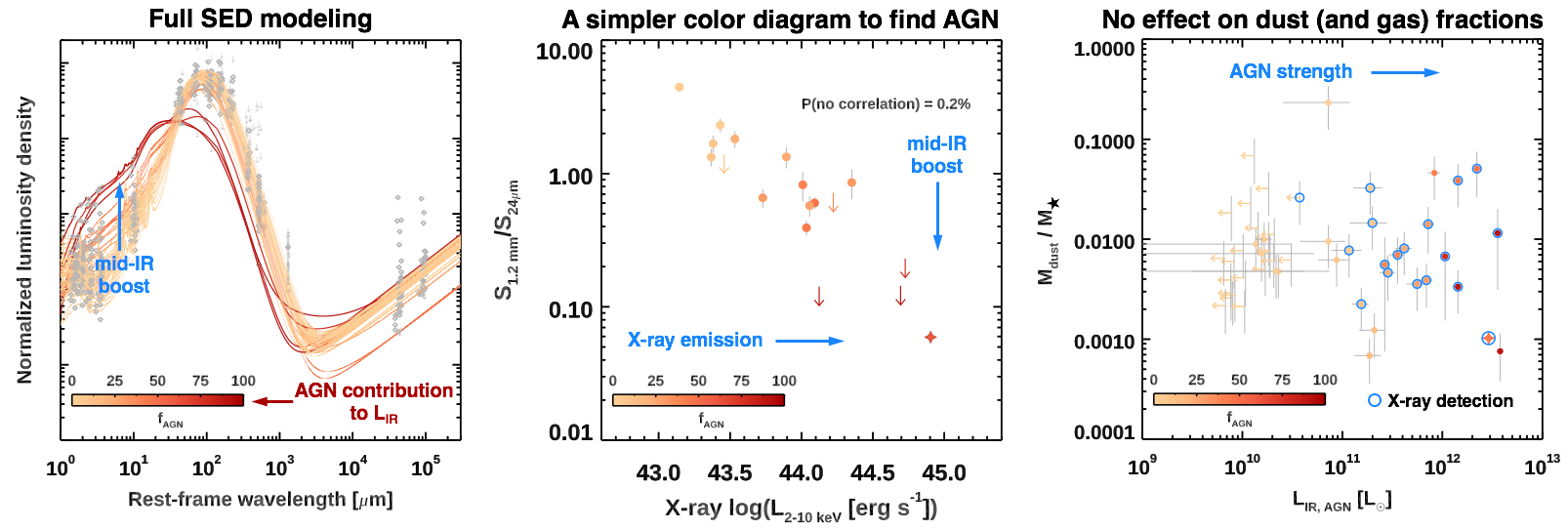

ALMA has given a decisive impulse to the study of the molecular gas and dust in distant star-forming galaxies. In particular, it opened the door for studies of main-sequence galaxies representative of the bulk of the star-forming population, overcoming the biases of samples limited to the brightest starbursting objects. In this framework, we have been conducting a multi-cycle and multi-wavelength ALMA survey of several tens of infrared-selected galaxies on and above the main-sequence at z~1.1-1.7. We targeted several carbon monoxide (CO) transitions (J=2,4,5,7) and their underlying dust continuum emission to investigate the properties of cold gas and dust of "normal" and "extreme" star-forming galaxies and study the physics behind their different growing modes.
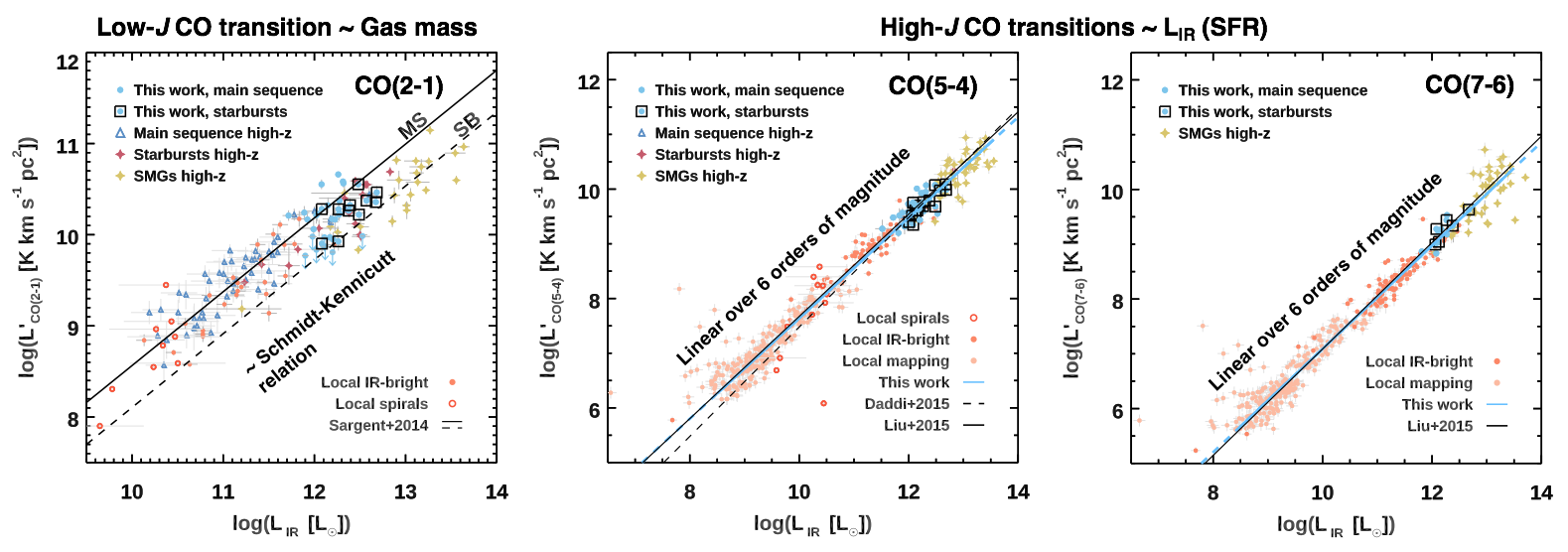
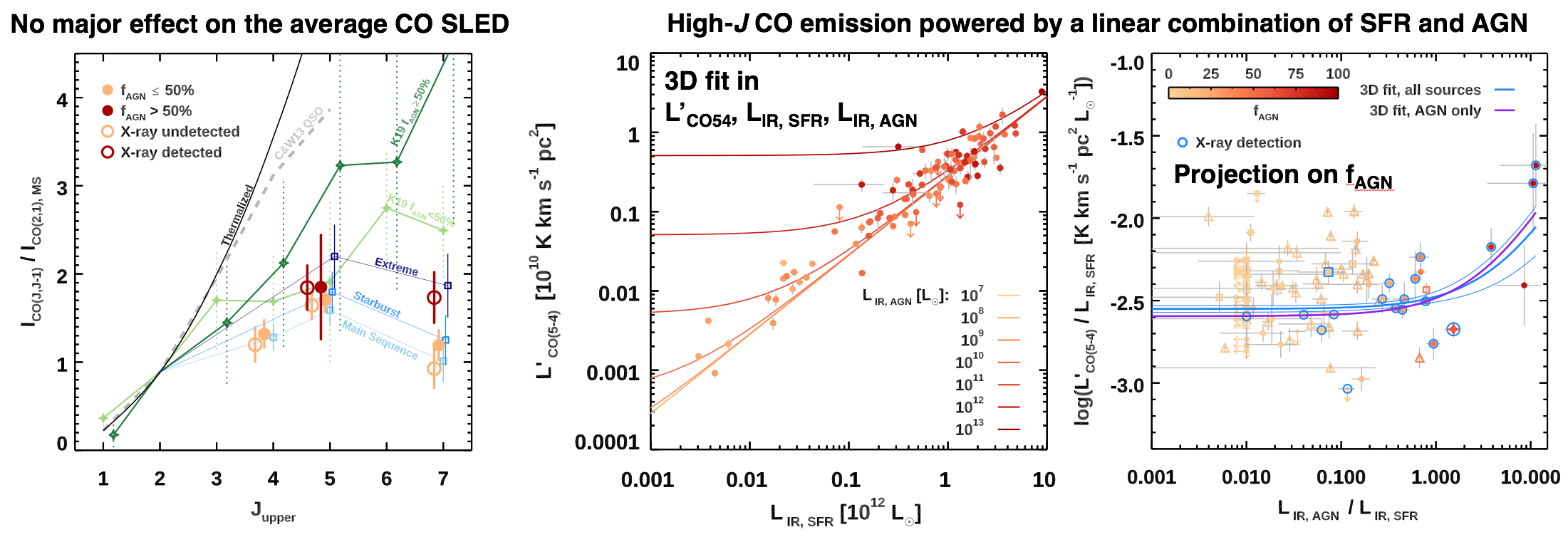
The CO(5-4) and (7-6) L' luminosities of main-sequence and starburst galaxies linearly correlate with the total infrared luminosity from star formation LIR over several orders of magnitude and across redshifts, making them good tracers of the obscured star formation SFR. The CO(2-1) luminosity sub-linearly correlates with LIR as expected for a classical total molecular gas mass tracer and the Schmidt-Kennicutt relation with a smooth variation from main-sequence to starburst galaxies and a redshift evolution. The former have longer depletion timescales or lower star formation efficiencies than starbursts, in agreement with past work.
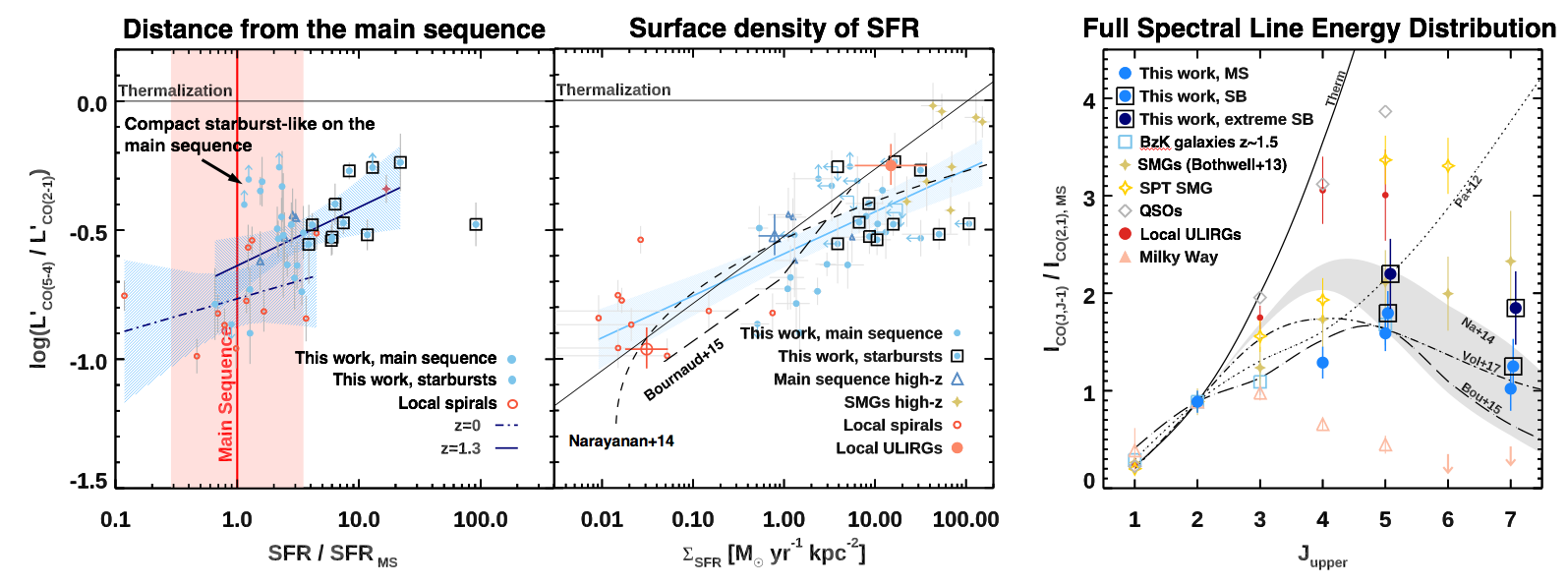
Using the CO(5-4)/CO(2-1) L' luminosity ratio as a proxy for the gas excitation, we find that the distance from the main sequence is not the best predictor of the conditions of the molecular gas in galaxies: a population of compact objects with starburst-like line ratios is evident on the main sequence, pairing with shorter depletion timescales and higher star formation efficiencies (Puglisi, Daddi, Liu+2019; Puglisi, Daddi, Valentino+2021). This is also evident from the average full spectral line energy distribution (SLED): we do find a trend with the distance from the main sequence, but the properties of main-sequence and starburst galaxies are not significantly different up to J=5, 7 at this stage despite the statistics. A large intrinsic variety of high/low-J line ratios is present even in a homogeneously infrared-selected population of main-sequence galaxies.
The surface density of SFR (~SFR/size2) offers an empirical way out to predict the properties of the cold interstellar medium by naturally accounting for compact objects on and above the main sequence (Valentino, Daddi, Puglisi+2020c). It is also theoretically well supported (Narayanan & Krumholz 2014): compact gas geometries trigger similarly dense SFR configurations where the highly efficient formation of new stars and the copious production of UV, X-ray photons, and cosmic rays plus the dust-gas interaction generate the observed trends. This also suggests a better definition of different growing modes based on the surface density of SFR, surpassing the classical classification of "main-sequence" and "starburst" galaxies relying on SFRs and stellar masses.