
From Sola et al 2022 (A&A in press, arXiv:2203.03973):
According to hierarchical model of galactic evolution, galaxies form through successive mergers, accretion of small systems and smooth accretion of gas.
These interactions leave collisional Low Surface Brightness (LSB) debris around galaxies, such as tidal tails, streams or shells. Studying these tidal debris is essential to constrain models of galactic evolution, as their origin and properties depend on the type and characteristics of the collisions.
Most studies that focused on tidal debris outside the Local Group have performed numerical census of these structures, either through visual inspection or more recently with deep learning. Detailed analysis including photometry has been carried out for a small number of objects
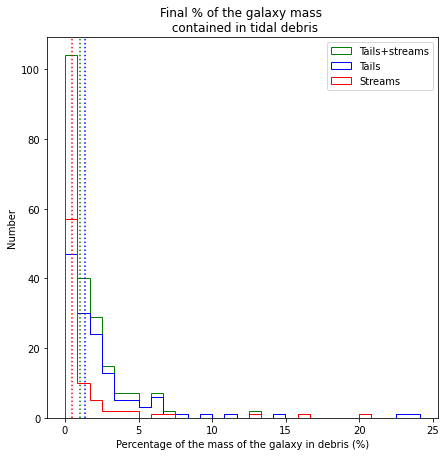
Yet, essentially because of the lack of convenient tools able to precisely study tidal debris, characterization of such LSB structures around large samples of galaxies had not been performed: this is the goal of this Paper.
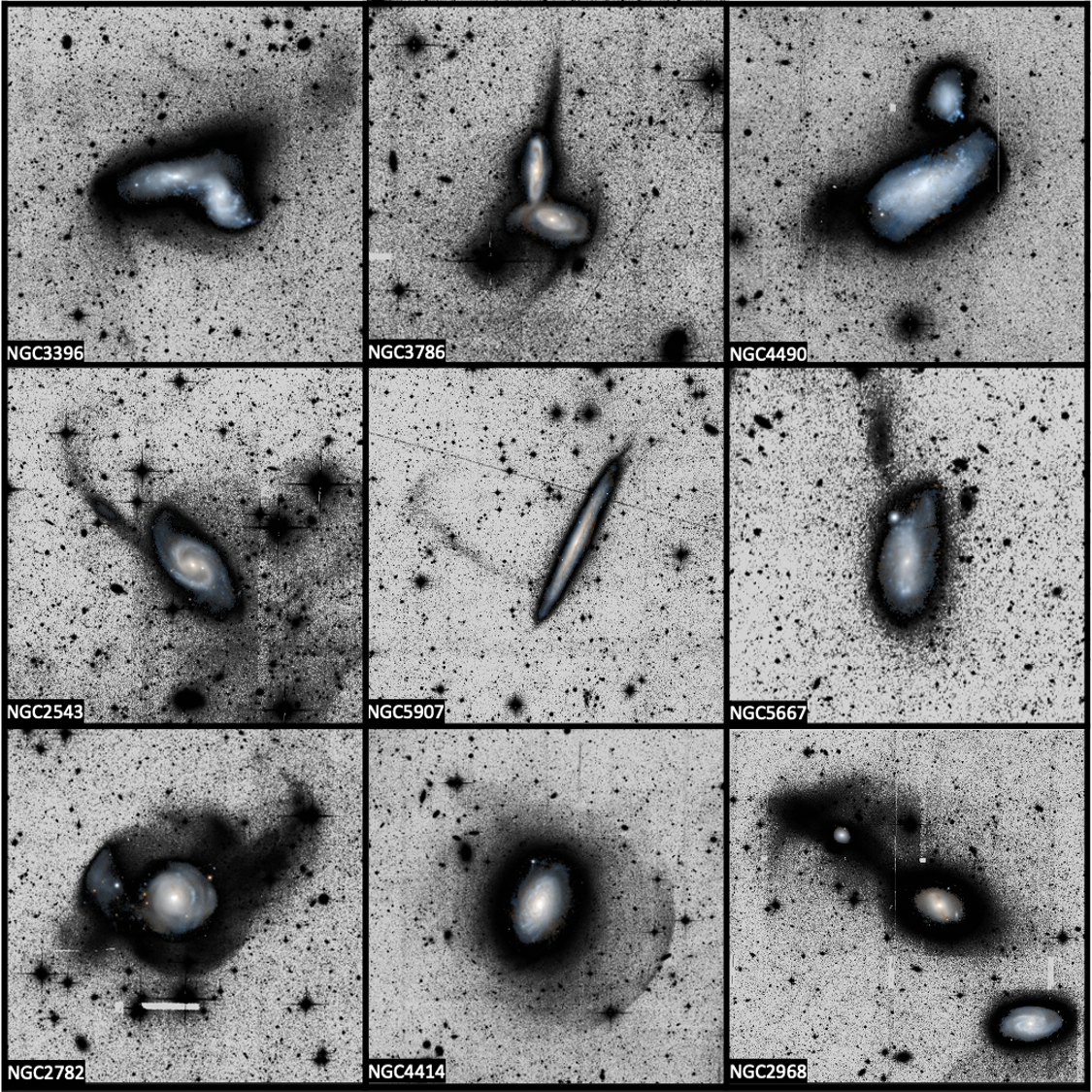
Examples of tidal features detected in CFIS r-band images displayed with a asinh scale. A true color image from the PanSTARRS DR1 survey is overlaid at the center of the target galaxy. The first row shows tidal tails and plumes, the middle row streams and the bottom one shells.