
Connecting tidal features with galaxy kinematics and more precise merger history

Ivana Ebrova 1 , Michal Bílek 2,3 , Ana Vudragović 4 , Mustafa K. Yıldız 5,6 , Pierre-Alain Duc 7 , Ewa L. Łokas 8 , Michael  Prouza 1

  • 1 FZU – Institute of Physics of the Czech Academy of Sciences, Prague
  • 2 LERMA, Observatoire de Paris, CNRS, PSL Univ., Sorbonne Univ., Paris
  • 3 Collège de France, 11 place Marcelin Berthelot, Paris
  • 4 Astronomical Observatory, Belgrade
  • 5 Astronomy and Space Sciences Department, Science Faculty, Erciyes University, Kayseri
  • 6 Erciyes University, Astronomy and Space Sciences Observatory Applied and Research Center (UZAYBIMER),, Kayseri
  • 7 Université de Strasbourg, CNRS, Observatoire astronomique de Strasbourg (ObAS), Strasbourg
  • 8 Nicolaus Copernicus Astronomical Center, Polish Academy of Sciences, Warsaw

Abstract

Substructures in stellar haloes carry a wealth of information about the host galaxies and their merger histories. Merger events leave behind interaction signs in the outskirts of the galaxies such as streams, tails, shells, or asymmetric stellar halos.
Using Illustris simulations, we investigated how the merger histories of early-type galaxies affect the presence of kinematic features in those galaxies and that recent significant merger events are more tightly correlated with the birth of prolate rotation than with kinematically decoupled cores. Specifically, we studied the incidence of stellar shells among the host galaxies in Illustris.

On the observation side, by combining archival and newly obtained data, we are assembling deep images of a complete sample of known nearby prolate rotators to assess their merger history. At this point, we gained deep observation of the majority of the sample and it already shows a statistically significant overabundance of interaction signs compared to a general sample of early-type galaxies of the MATLAS deep imaging survey.

Shells are the most common interaction sign in our sample of observed prolate rotators. The unique kinematics of shells allow for more precise estimations of the times of the mergers that can be compared with the prediction from the cosmological simulations. In our ongoing project, we are going to compute the merger times not only for the prolate rotators but for hundreds, and in the near future, potentially thousands of shell galaxies. This will provide a new, more precise insight into the recently merger history of our Universe.

Introduction

Tidal features

Galaxy interactions, most prominently mergers, leave behind features in stellar halos that can be observed, with sufficiently deep images, up to several gigayears after the event.
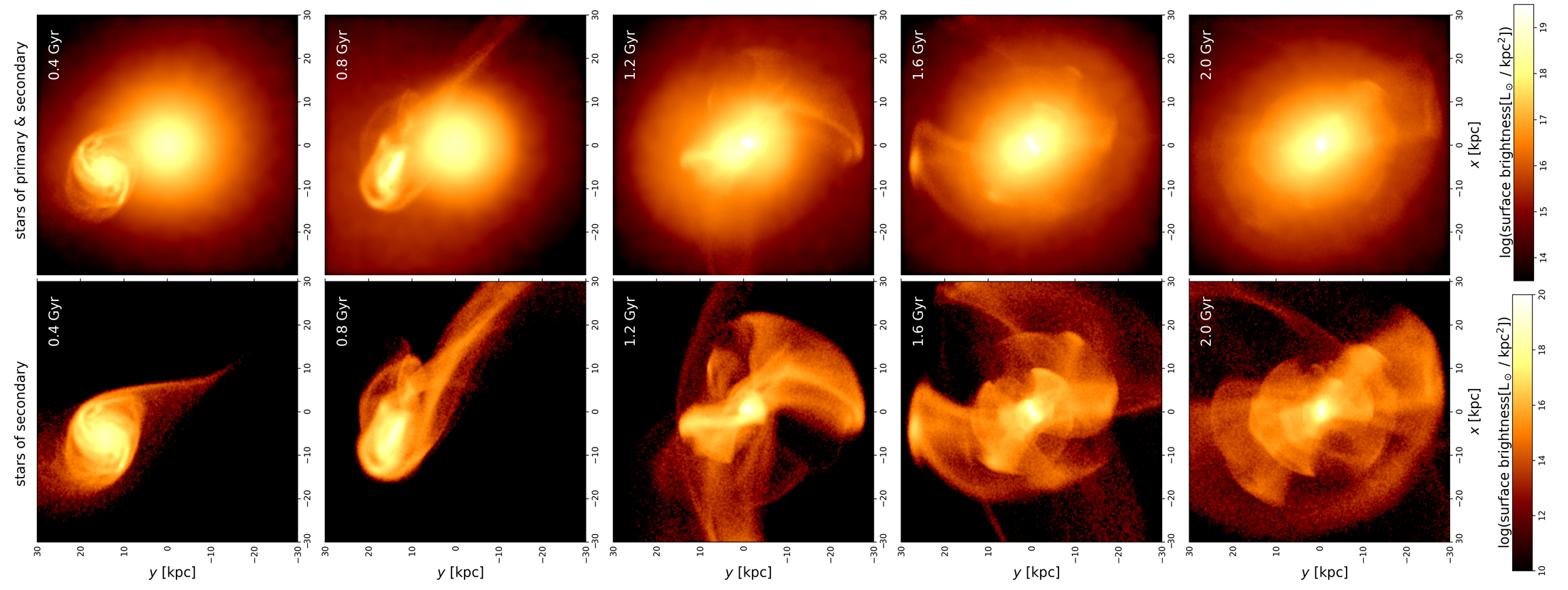
Snapshots from a Gadget-2 simulation of a merger with 1:10 stellar-mass ratio, elliptical primary galaxy and secondary with inclined disk and 6 kpc impact parameter (for more details see Ebrová et al. 2020) 

Especially in the later stages of the merger simulation, you can see multiple stellar shells around the host galaxy. The shells are made of stars of the secondary galaxy that end up on highly eccentric orbits after the merger. Their special kinematics allow the investigation of the time of the merger or the gravitational potential of the host galaxy.

See also a related poster on projection effects in shell galaxies

Kinematical features

The origin of different kinematical peculiarities in ETGs is not yet fully understood. The most well-known such features are kinematically decoupled cores and prolate rotation (also called “minor-axis rotation”). Prolate rotators are galaxies that appear to be rotating predominantly around its major morphological axis. They constitute several percent of all ETGs and up to half of the very massive galaxies.
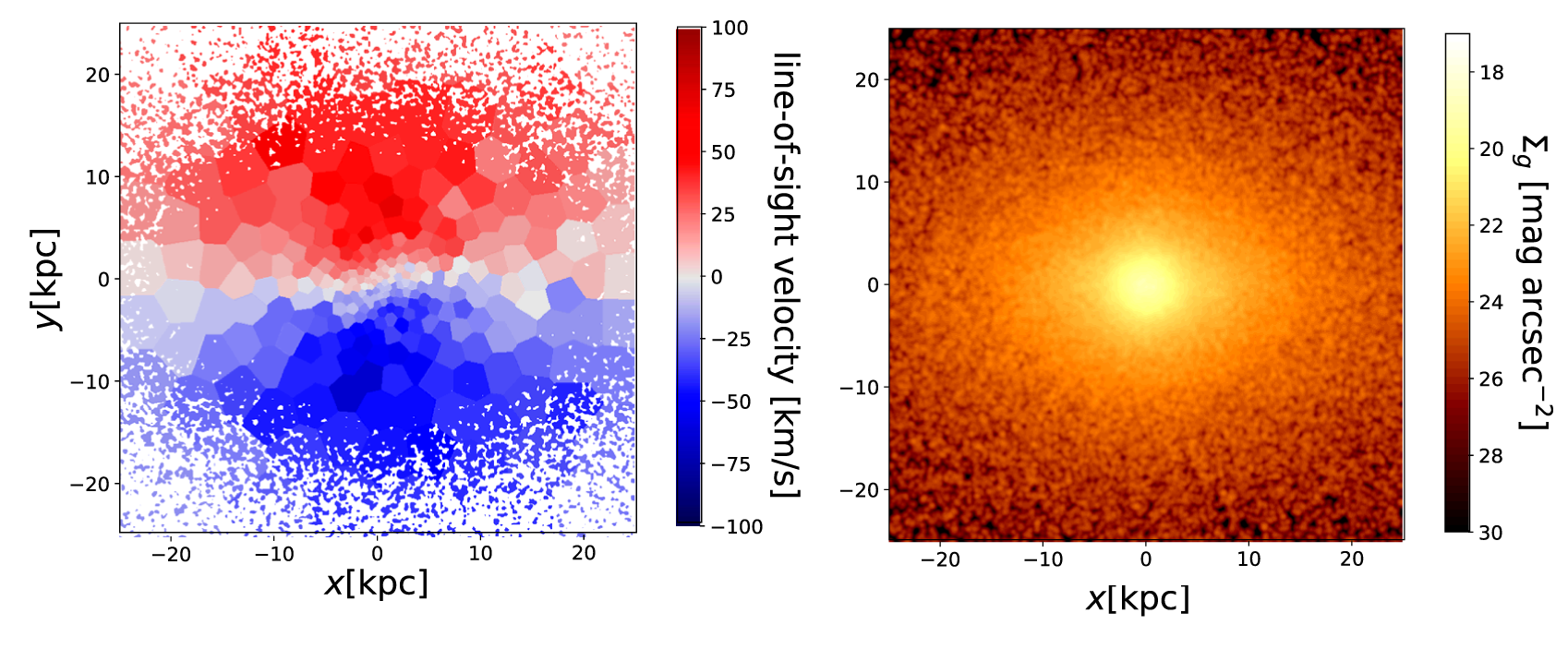
An example of an elliptical galaxy with prolate rotation from the Illustris large-scale cosmological simulation (for more details see Ebrová & Łokas 2017)

References

Bílek, M., Bartošková, K., Ebrová, I., & Jungwiert, B. 2014, A&A, 566, A151

Bílek, M., Cuillandre, J.-C., Gwyn, S., et al. 2016, A&A, 588, A77

Bílek, M., Duc, P.-A., Cuillandre, J.-C., et al. 2020, MNRAS, 498, 2138

Bílek, M., Fensch, J., Ebrová, I., et al. 2022, A&A, 660, A28 

Bílek, M., Jungwiert, B.. Jílková, L., et al. 2013, A&A, 559, A110 

Dey, A., Schlegel, D. J., Lang, D., et al. 2019, AJ, 157, 168

Duc, P.-A., Cuillandre, J.-C., Karabal, E., et al. 2015, MNRAS, 446, 120

Ebrová, I., Bílek, M., Vudragović, A., Yıldız, M. K., & Duc, P.-A. 2021, A&A, 650, A50 

Ebrová, I., Bílek, M., Yıldız, M. K., & Eliášek, J. 2020, A&A, 634, A73

Ebrová, I., & Łokas, E. L. 2017, ApJ, 850, 144

Ebrová, I., Łokas, E. L., & Eliášek, J. 2021, A&A, 647, A103 

Merger history of Prolate Rotators

In Ebrová & Łokas (2017) and Ebrová, Łokas, & Eliášek (2021) we investigated kinematical features among ETGs in the Illustris large-scale cosmological hydrodynamical simulation. We found the origin of prolate rotation in massive ETGs to be strongly connected to relatively recent major mergers. 

In Ebrová et al. (2021), we examined 19 observed prolate rotators with available deep optical images and found morphological signs of galaxy interaction in all of them, which proves to be a statistically very significant correlation when compared with a general sample of ETGs in MATLAS — a deep imaging survey (Duc et al. 2015, Bílek et al. 2020). 

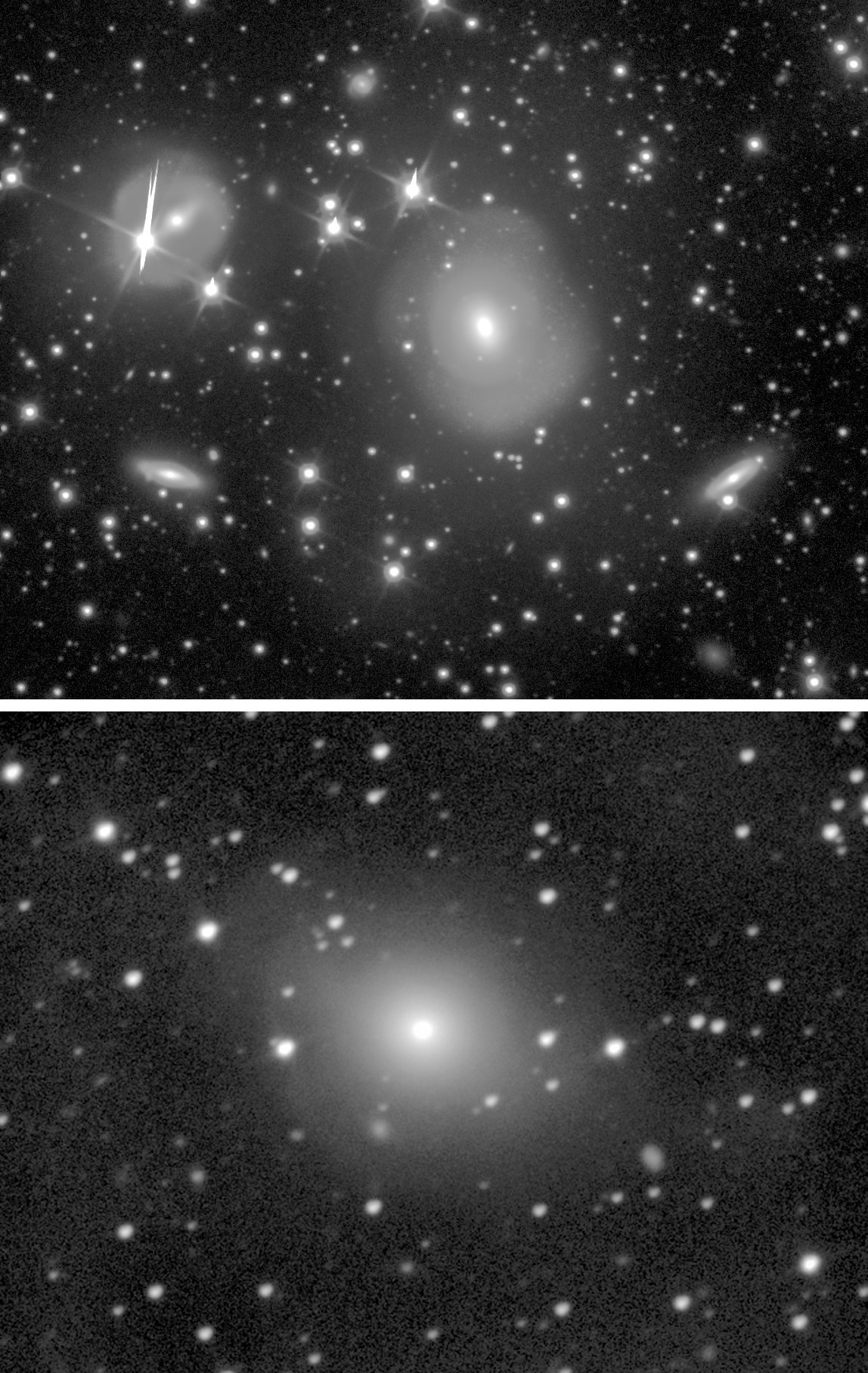
In our current project, we use the 1.4m Milankovic Telescope at Vidojevica observatory to assemble deep optical images of the complete sample of all known nearby massive prolate rotators. So far, we observed 5 out of 8 additional prolate rotators and preliminary processing shows signs of galaxy interactions in all five. 

Moreover, the most frequent features among the prolate rotators happen to be shells. This will allow us to make estimates of the time of mergers for a large portion of the sample and compare it with the predictions of the merger history of prolate rotators in the Illustris simulation.

Preliminary processed new deep optical images of two prolate rotators from the 1.4m Milankovic Telescope at Vidojevica observatory

Acknowledgements

This project has received funding from the European Union's Horizon Europe Research and Innovation programme under the Marie Skłodowska-Curie grant agreement No. 101067618-GalaxyMergers (IE).

We acknowledge the support from the Polish National Science Centre under the grant 2017/26/D/ST9/00449 (IE and MB).


Disclaimer: Funded by the European Union. Views and opinions expressed are however those of the author(s) only and do not necessarily reflect those of the European Union or European Research Executive Agency (REA). Neither the European Union nor REA can be held responsible for them.

Merger history of the Universe

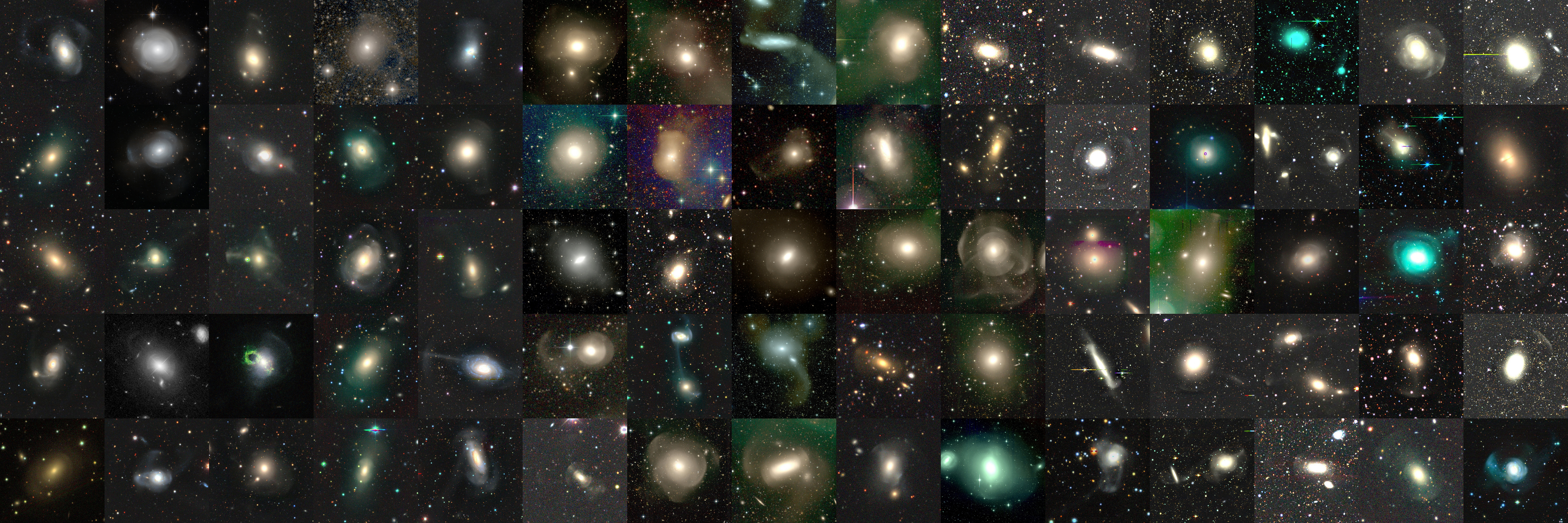
Selection of a fraction of known shell galaxies:

Sources of the images: DESI Legacy Imaging Surveys (Dey et al. 2019); MATLAS (Duc et al. 2015, Bílek et al. 2020); NAOJ/HSC Collaboration; HST; SDSS

In Bílek et al. (2013) and Bílek et al. (2014), we developed the ‘shell identification method.’ So far, we applied it to several special cases of shell galaxies to explore the host gravitational potential and derive the time of the galaxy mergers undergone by the hosts (Bílek et al. 2016, Ebrová et al. 2020, Bílek et al. 2022; see also a related poster about the shell galaxy NGC 474).

There are hundreds of known shell galaxies, more available in current data, and much more will be observed in the next few years in upcoming large deep surveys like the Large Survey of Space and Time (LSST) at the Vera C. Rubin Observatory. We are developing tools to extract fairly accurate estimates of the merger times for large samples. This will transform shell galaxies from a position of curiosity to that of utility, allowing statistical applications using the merger data on thousands of shell galaxies.